
Reconstituting a lyophilised peptide is the first step toward using it in a laboratory experiment. Lyophilised (freeze‑dried) powders must be dissolved in a suitable solvent to produce a stock solution of known concentration. This process, called reconstitution, is more than simply adding water—it requires consideration of the peptide’s solubility, the desired concentration and long‑term stability. Peptides are fundamental to numerous biological processes and can modulate metabolism, immune responses and cell signaling; accordingly, their preparation demands care.
This guide provides an authoritative, step‑by‑step framework for reconstituting peptides. It covers solvent selection, concentration calculations, dilution strategies and storage. Whether you are preparing a 1 mg vial or a 10 mg bulk sample, these principles will help ensure your solutions are reliable and reproducible. Remember: all information here is intended for research planning, not clinical use.
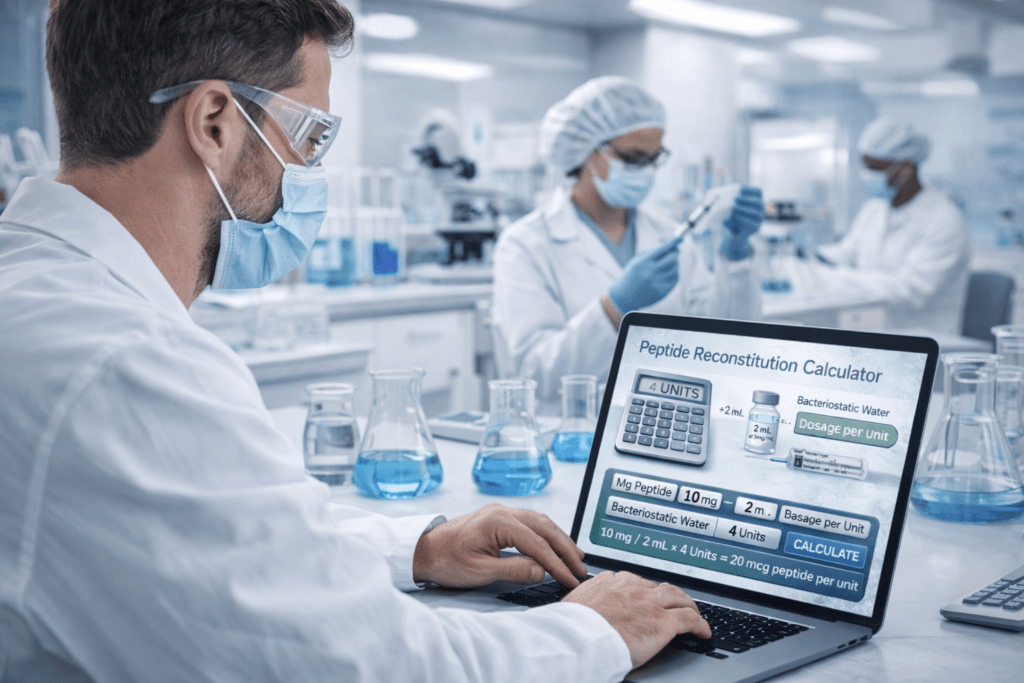
What Is Peptide Reconstitution?
Peptide reconstitution refers to dissolving a dry peptide powder into a liquid to make a solution. Peptides are chains of amino acids, and their solubility depends on sequence, length and side‑chain chemistry. Generally, small peptides and those with polar residues dissolve readily in aqueous solvents, while hydrophobic peptides may require organic co‑solvents or pH adjustments. The goal is to create a homogeneous solution with a known concentration.
To start, determine the mass of the peptide (e.g., 2 mg, 5 mg or 10 mg). Next, select a solvent recommended by the manufacturer—commonly sterile water for injection (WFI), bacteriostatic water or a buffer. Dissolving the peptide in a small volume of solvent (e.g., 1–5 mL) yields a concentrated stock solution. The concentration is calculated by dividing the mass by the volume; a 5 mg vial dissolved in 5 mL produces 1 mg/mL. For hydrophobic peptides, adding a few microlitres of DMSO may aid solubility before dilution with aqueous solvent.
Understanding Peptide Concentration and Solution Strength
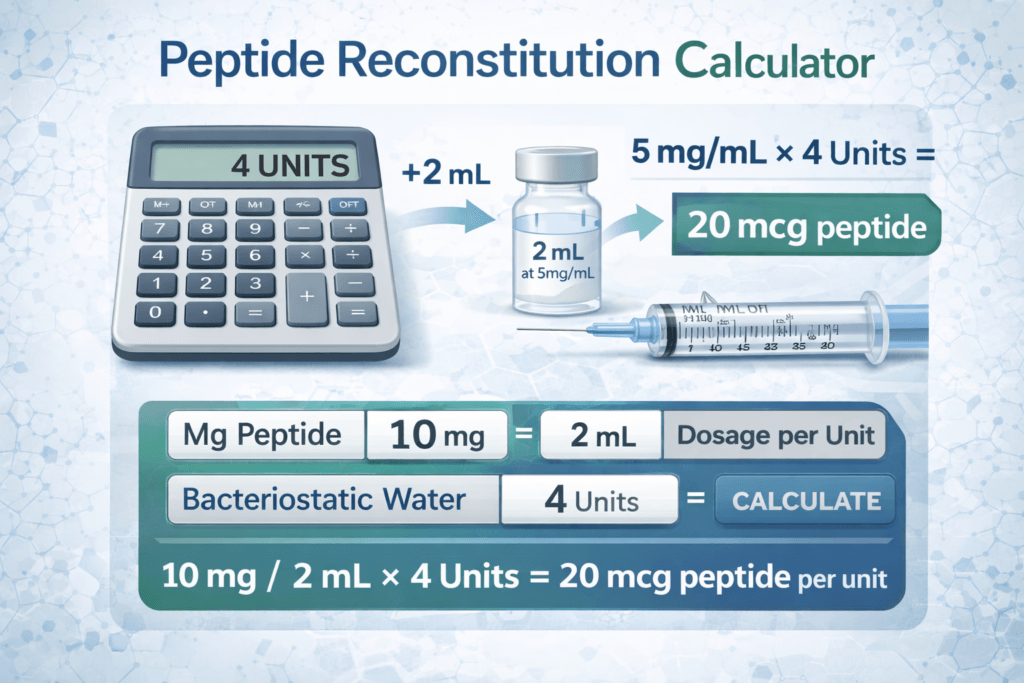
Peptide concentrations are expressed in mass per volume (e.g., mg/mL). Knowing metric conversions is essential: 1 mg = 1,000 µg and 1 g = 1,000 mg; 1 mL = 0.001 L. When reconstituting, pick a volume that results in a convenient concentration.
For example, dissolving a 10 mg peptide in 4 mL yields a 2.5 mg/mL stock. Converting to µg/mL gives 2,500 µg/mL. Because some experiments require microgram amounts, this conversion clarifies how much stock to withdraw. Using a 1 mL syringe marked in 100 units, each unit equals 0.01 mL and will contain 25 µg of peptide at 2.5 mg/mL. Understanding these relationships ensures accurate aliquoting and dilutions.
The Mathematics Behind Reconstitution and Dilution
Several equations guide reconstitution:
- Stock concentration: C = mass ÷ volume. Dissolving 10 mg in 4 mL gives C = 10 mg / 4 mL = 2.5 mg/mL.
- Unit conversion: To convert mg to µg, multiply by 1,000. To convert mL to units on a syringe, multiply by 100 (because 1 mL = 100 units).
- Dilution calculation: Use C₁V₁ = C₂V₂ to prepare a working solution at a lower concentration. Suppose you need 500 µg in a final volume of 1 mL. If your stock is 2.5 mg/mL (2,500 µg/mL), V₁ = (500 µg × 1 mL) ÷ 2,500 µg/mL = 0.20 mL. You will withdraw 0.20 mL (20 units) and add 0.80 mL of solvent.
These calculations provide a roadmap for creating solutions with predictable concentrations.
Step‑by‑Step Research Preparation Framework
- Review the peptide’s solubility. Check product documentation for solvent recommendations. Hydrophobic peptides may require DMSO or acetonitrile as a co‑solvent.
- Plan the stock concentration. Select a volume that results in a round-number concentration (e.g., 1 mg/mL, 2 mg/mL). This makes later dilutions easier.
- Reconstitute with care. Add solvent gradually along the vial wall to avoid foaming. Gently swirl or flick until the peptide dissolves completely. Do not shake vigorously, as this can cause aggregation.
- Calculate and perform any dilutions. If your stock concentration is higher than needed, use C₁V₁ = C₂V₂ to make a working solution. For example, if you need 0.5 mg/mL for your assay, dilute the stock accordingly.
- Aliquot and store. Divide the stock into small aliquots (e.g., 100–200 µL) and store at recommended temperatures (often −20 °C or −80 °C). Avoid repeated freeze–thaw cycles by thawing only the amount needed.
Using a Peptide Calculator for Precision
A peptide calculator is invaluable during reconstitution. It allows you to enter the peptide mass and desired concentration and returns the exact volume of solvent required. When diluting, it calculates how much stock to combine with solvent to achieve your target concentration. This reduces manual math and ensures consistency across multiple preparations. Synagenics provides an integrated calculator below for these purposes:
Common Calculation Errors and How to Avoid Them
- Adding too much solvent. Over‑diluting the peptide results in a very low concentration, requiring larger volumes for experiments. Choose an appropriate volume from the start.
- Incomplete dissolution. Residual particles indicate that the peptide has not fully dissolved. Ensure gentle mixing and consider adding a small amount of an organic co‑solvent if allowed.
- Contamination. Use sterile techniques to prevent microbial growth, especially when using bacteriostatic water. Work in a laminar flow hood if available.
- Not accounting for dead volume. Transfer as much solution as possible when aliquoting, but recognise that tiny amounts remain in syringes and needles.
Documenting each step and verifying calculations helps prevent these mistakes.
Frequently Asked Research Questions
What solvent should I use to reconstitute my peptide? Consult the product sheet. Most peptides dissolve in sterile water, but hydrophobic sequences may require a small amount of DMSO or acidic/basic buffer.
Can I reuse a reconstituted peptide solution after thawing? To preserve activity, aliquot the stock and avoid repeated freeze–thaw cycles. Discard unused thawed aliquots.
Do all peptides require reconstitution? Lyophilised peptides do. Some suppliers offer ready‑to‑use solutions, but the principles of concentration and dilution still apply.
How do I ensure sterility during reconstitution? Use sterile syringes and solvents. Work under aseptic conditions and filter sterilise if needed.
What if my peptide precipitates after reconstitution? Gently warm the solution or add a drop of solvent recommended for solubilising hydrophobic peptides. If precipitation persists, consult the manufacturer for guidance.
Research & Scientific Literature
Bioactive peptides exhibit diverse biological functions. Peptide hormones regulate metabolism and homeostasis, while other peptides act as growth factors, neurotransmitters or immunomodulators. As research tools, synthetic peptides enable scientists to probe receptor–ligand interactions and signal transduction pathways. PubMed and Google Scholar host thousands of studies detailing peptide synthesis, solubility optimization and applications. Reading peer‑reviewed literature enhances understanding of how reconstitution conditions can influence experimental outcomes.
Related Synagenics Resources
- Reconstitution Calculator – automatically determine volumes for dissolving peptides.
- GLP‑3rt and GLP‑2tz – research peptides that may require specific reconstitution protocols.
- Synagenics Shop – browse a wide selection of research peptides and reagents.
- Synagenics Blog – articles on lab techniques, including peptide handling.
- NAD500 and 5‑Amino‑1MQ – learn about complementary metabolic research compounds.
- What Is NAD? – explore the role of NAD+ in cellular metabolism.
Compliance Disclaimer
This guidance is for laboratory research use only. Peptides and calculations described herein are not for human or veterinary use. Handle peptides according to institutional safety protocols.