
SYN-3R research peptide is studied in laboratory environments to better understand glucagon-like peptide (GLP) receptor signaling. Researchers examine how this peptide interacts with receptor systems, activates intracellular pathways, and maintains structural stability under controlled conditions.
In peptide science, clarity and structure matter. Therefore, this page explains SYN-3R research peptide in a direct and organized way. We will review its molecular characteristics, receptor biology, laboratory handling standards, and analytical quality benchmarks. All discussion remains focused on research applications.
GLP receptor systems belong to a well-documented family of G protein-coupled receptors (GPCRs). Because of this, SYN-3R research peptide is often evaluated in signaling models that measure receptor activation and downstream pathway responses.

What Is SYN-3R Research Peptide
SYN-3R research peptide is an engineered peptide designed for laboratory investigation of GLP receptor pathways. It belongs to a broader class of peptides that interact with class B GPCRs.
Peptides in this category are commonly studied for:
- Receptor-binding affinity
- Signal transduction behavior
- Intracellular messenger activation
- Structural stability
- Degradation resistance
Unlike large proteins, peptides are shorter amino acid chains. Because of their size, they often allow precise modeling of receptor interaction. As a result, researchers use SYN-3R research peptide in controlled in vitro systems to analyze receptor signaling behavior.
Importantly, SYN-3R research peptide is supplied strictly for laboratory research. It is not positioned for diagnostic, therapeutic, or personal use. All evaluation occurs within biochemical or cellular research settings.

Receptor Signaling & Biological Pathways
GLP receptor systems are part of the G protein-coupled receptor superfamily. These receptors sit on the cell surface and respond to peptide ligands. When a compatible peptide binds, the receptor undergoes a conformational change. This change triggers intracellular signaling.
In laboratory models, SYN-3R research peptide is examined for its ability to influence signaling cascades such as:
- Adenylyl cyclase activation
- Cyclic AMP (cAMP) production
- Protein kinase A (PKA) signaling
- Mitogen-activated protein kinase (MAPK) pathways
- Receptor internalization and recycling
Researchers often measure these pathways using cell-based assays. For example, cAMP accumulation assays can quantify receptor activation strength. Similarly, phosphorylation studies help evaluate downstream protein activity.
Because GLP receptors belong to class B GPCRs, signaling may involve multiple intracellular intermediates. Therefore, laboratory studies typically analyze both immediate signaling events and longer-term receptor regulation patterns.
Advanced Signaling Dynamics & Receptor Conformational Behavior
Beyond initial receptor activation, GLP receptor systems exhibit complex conformational dynamics that influence downstream signaling profiles. Class B G protein-coupled receptors (GPCRs), including GLP-associated receptors, operate through coordinated structural rearrangements that extend from the extracellular ligand-binding domain through the transmembrane helices to intracellular coupling interfaces.
When a research peptide such as SYN-3R interacts with the receptor, binding does not simply “switch on” a pathway. Instead, ligand engagement stabilizes specific receptor conformations. These conformations determine which intracellular signaling partners are recruited and how efficiently signaling is propagated.
In laboratory models, researchers frequently analyze:
- Gs protein coupling efficiency
- Cyclic AMP (cAMP) generation kinetics
- Temporal phosphorylation patterns
- Beta-arrestin recruitment behavior
- Receptor desensitization and recycling rates
The concept of “signaling bias” has become increasingly relevant in peptide-receptor research. Signaling bias refers to the ability of different ligands to preferentially activate certain intracellular pathways over others, even when binding to the same receptor. In experimental systems, structural variations within a peptide sequence may alter receptor conformational stability, leading to distinct signaling fingerprints.
For GLP-family peptides, this phenomenon is often explored by comparing second messenger production with receptor internalization rates. Some ligands may promote strong early cAMP accumulation, while others may demonstrate sustained signaling through altered receptor trafficking patterns. These distinctions are evaluated using quantitative assays such as real-time cAMP monitoring, phosphorylation analysis, and receptor surface expression studies.
Receptor internalization represents another key regulatory mechanism. After activation, GPCRs may undergo phosphorylation at intracellular domains, which facilitates beta-arrestin binding. Beta-arrestin acts both as a scaffold for alternative signaling pathways and as a mediator of receptor endocytosis. Internalized receptors can either be recycled back to the membrane or directed toward degradation pathways. These processes influence signal duration and overall receptor responsiveness.
Understanding these regulatory dynamics is essential when characterizing peptide behavior in laboratory environments. A peptide’s functional profile cannot be defined solely by its binding affinity; it must also be evaluated in terms of activation kinetics, signal persistence, and receptor regulation patterns.
Scientific literature describing GLP receptor conformational mechanisms, GPCR activation models, and ligand-induced structural rearrangements can be explored through indexed databases such as:
PubMed: https://pubmed.ncbi.nlm.nih.gov
Google Scholar: https://scholar.google.com
These resources provide foundational research on class B GPCR structural biology, peptide-receptor interaction models, and intracellular signaling architecture.
Within controlled experimental systems, SYN-3R research peptide may be evaluated across multiple assay platforms to assess its influence on receptor dynamics. Such investigations contribute to broader understanding of peptide engineering principles and receptor-mediated signaling frameworks, reinforcing the importance of structural precision and analytical validation in peptide research.
Molecular Characteristics & Peptide Engineering
The structure of SYN-3R research peptide plays a central role in its laboratory behavior. Peptide engineering focuses on optimizing sequence stability while maintaining receptor interaction properties.
Key molecular factors studied include:
- Amino acid sequence composition
- Molecular weight
- Secondary structure tendencies
- Hydrophobic and hydrophilic balance
- Conformational flexibility in solution
Small changes in amino acid sequence can influence receptor binding kinetics. Therefore, structural analysis is essential. Researchers often use analytical techniques to confirm peptide identity and integrity before conducting signaling experiments.
Common analytical tools include:
- High-Performance Liquid Chromatography (HPLC)
- Mass Spectrometry (MS)
- Amino acid sequence verification
- Spectroscopic evaluation
HPLC confirms purity by separating the peptide from potential impurities. Mass spectrometry verifies molecular weight and structural accuracy. Together, these methods ensure that SYN-3R research peptide meets laboratory-grade standards.
Research Applications of SYN-3R
SYN-3R research peptide is used in controlled laboratory settings to study receptor behavior and peptide stability. Its applications remain focused on molecular and biochemical research.
Typical laboratory investigations include:
Receptor Binding Studies
Researchers evaluate binding affinity using fluorescence or radioligand assays. These tests measure how efficiently the peptide interacts with receptor targets.
Signal Transduction Analysis
Cell-based assays help quantify second messenger production. cAMP assays are commonly used to measure receptor activation.
Comparative Peptide Modeling
SYN-3R research peptide may be compared with other GLP-family peptides to examine structural differences in receptor interaction.
Stability Testing
Environmental factors such as temperature and pH can affect peptide integrity. Stability testing ensures reproducibility across experimental conditions.
Each application supports a broader understanding of peptide-receptor interaction within laboratory models.
Lyophilized Format & Stability
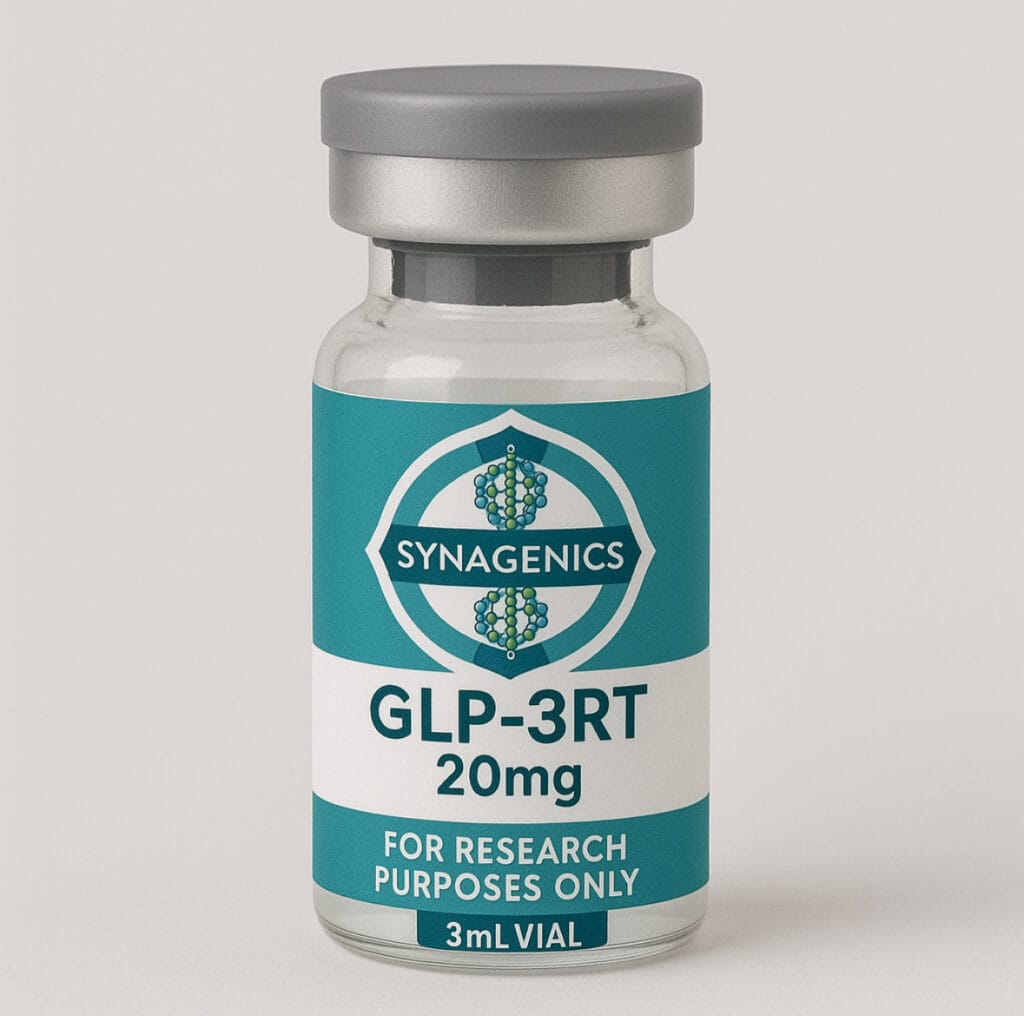
SYN-3R research peptide is typically supplied in lyophilized form. Lyophilization removes moisture, which helps preserve molecular stability during storage and transport.
Advantages of this format include:
- Reduced degradation risk
- Improved storage stability
- Lower moisture exposure
- Consistent laboratory handling
Proper storage conditions often involve controlled temperature ranges and protection from light. In addition, minimizing repeated freeze-thaw cycles helps maintain structural integrity.
Before laboratory preparation, researchers inspect the vial to confirm that the peptide appears uniform and free from visible irregularities.
Laboratory Preparation & Handling (High Level)
Accurate handling supports reliable research outcomes. SYN-3R research peptide should be prepared using sterile laboratory equipment and validated internal protocols.
High-level handling principles include:
- Use of sterile solvents
- Gentle mixing techniques
- Accurate concentration calculations
- Controlled environmental conditions
To assist with laboratory calculations, Synagenics provides a reference tool here:
https://synagenics.com/reconstitution-calculator/
Researchers should document preparation steps to maintain reproducibility across experiments. Consistent technique reduces variability in receptor signaling assays.
Analytical Characterization & Quality Standards
Quality control is essential in research peptide supply. SYN-3R research peptide undergoes analytical characterization to confirm purity and identity.
Standard quality verification methods include:
- HPLC purity testing
- Mass spectrometry confirmation
- Batch tracking
- Certificate of Analysis (CoA) documentation
HPLC provides quantitative purity data. Mass spectrometry confirms molecular weight alignment with the intended sequence. These procedures help ensure laboratory reliability and consistency.
Maintaining transparent analytical standards supports reproducible research outcomes and aligns with scientific best practices.
SYN-3R vs Related Research Peptides
SYN-3R research peptide may be compared with other GLP-family peptides to evaluate structural and signaling differences.
| Feature | SYN-3R | SYN-2T | Other GLP Peptides |
|---|---|---|---|
| Receptor Class | GLP receptor family | GLP-related pathways | Sequence-dependent |
| Primary Focus | Signaling analysis | Comparative modeling | Varies |
| Format | Lyophilized | Lyophilized | Variable |
| Analytical Testing | HPLC & MS | HPLC & MS | Lab-specific |
Frequently Asked Research Questions
What is SYN-3R research peptide used for?
It is examined in laboratory studies focused on GLP receptor signaling and peptide stability.
Is SYN-3R intended for medical use?
No. It is supplied strictly for laboratory research purposes.
How is purity verified?
Purity is confirmed using HPLC and mass spectrometry analysis.
Why is SYN-3R provided in lyophilized form?
Lyophilization improves storage stability and reduces degradation risk.
Where can researchers find literature on GLP receptor biology?
Indexed publications are available through PubMed and Google Scholar.
Does this page include dosing information?
No. Dosing guidance is not provided, as this product is for research use only.
Related Synagenics Resources
- https://synagenics.com/shop/syn-3r/
- https://synagenics.com/shop/SYN-2T-tirz/
- https://synagenics.com/shop/
- https://synagenics.com/blog/
- https://synagenics.com/what-is-nad/
🔬 SYN-3R Research Library
- SYN-3R Research Hub (Complete Overview)
- SYN-3R Research Peptide Overview
- SYN-3R Molecular Structure & Peptide Engineering
- SYN-3R Receptor Signaling & GPCR Activation
- SYN-3R Stability, Lyophilization & Laboratory Storage
For full research details, mechanism of action, and compound specifications — Read the full SYN-3R research page here.
Compliance Disclaimer
All information provided on this page is intended for laboratory research purposes only. Not medical advice.