
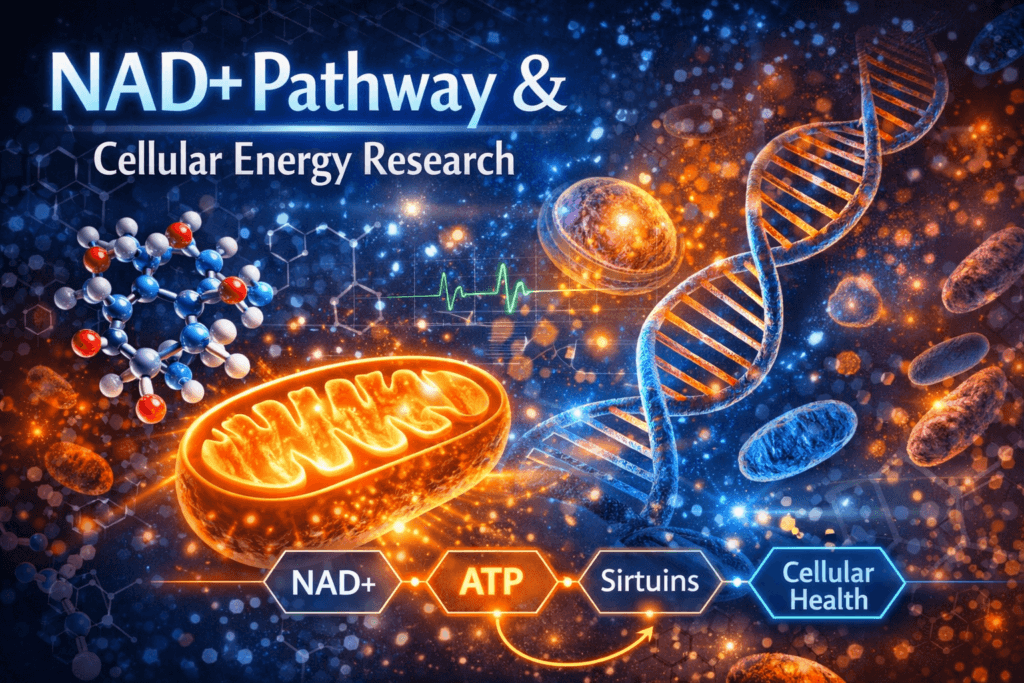
NAD+ (nicotinamide adenine dinucleotide) pathway research examines the biosynthesis, compartmentalization, consumption, and salvage of this central metabolic coenzyme across cellular and subcellular systems in controlled laboratory environments. As both an electron carrier in oxidative phosphorylation and a substrate for NAD+-consuming enzymes including sirtuins, PARPs, and CD38, intracellular NAD+ availability occupies a central position in the regulation of mitochondrial bioenergetics, DNA repair pathway activity, and cellular stress response signaling. Published reviews on NAD+ metabolism, sirtuin biology, and PARP pathway regulation have established this coenzyme’s broad relevance across cellular research frameworks involving energy homeostasis, genomic stability, and mitochondrial function. Rajman et al., 2018 — PubMed; Yoshino et al., 2018 — PubMed; Cantó et al., 2013 — PubMed
NAD+ Biosynthesis and Salvage Pathways
Intracellular NAD+ is synthesized through three primary biosynthetic routes in mammalian cells: the de novo pathway from tryptophan via the kynurenine pathway; the Preiss-Handler pathway from nicotinic acid; and the salvage pathway from nicotinamide, nicotinamide riboside (NR), or nicotinamide mononucleotide (NMN). The salvage pathway represents the predominant route of NAD+ biosynthesis in most mammalian tissues, with nicotinamide phosphoribosyltransferase (NAMPT) catalyzing the rate-limiting conversion of nicotinamide to NMN. Intracellular NAD+ is compartmentalized across cytoplasmic, mitochondrial, and nuclear pools — each supporting distinct NAD+-dependent enzymatic activities including oxidative phosphorylation, sirtuin deacetylation, and PARP-1-mediated DNA repair signaling. Rajman et al., 2018 — PubMed; Cantó et al., 2013 — PubMed
Sirtuin-Linked Signaling and Mitochondrial Biogenesis
Sirtuins are a family of seven NAD+-dependent deacetylase enzymes (SIRT1-7) that regulate diverse cellular processes through lysine deacetylation of target proteins in the nucleus, cytoplasm, and mitochondria. SIRT1 deacetylates PGC-1α — a master regulator of mitochondrial biogenesis — as well as FOXO transcription factors, p53, and NF-κB, linking NAD+ availability to transcriptional programs governing mitochondrial function and cellular stress response. SIRT3, localized to the mitochondrial matrix, deacetylates and activates components of the TCA cycle, ETC complexes, and antioxidant defense enzymes, connecting mitochondrial NAD+ levels to organelle bioenergetic efficiency. NAD+ precursor supplementation research has examined whether elevation of intracellular NAD+ can modulate sirtuin-dependent pathway activity across skeletal muscle, liver, and adipose tissue models. Cantó et al., 2013 — PubMed; Yoshino et al., 2018 — PubMed
NNMT Inhibition and NAD+ Precursor Availability
Nicotinamide N-methyltransferase (NNMT) is a cytoplasmic methyltransferase enzyme that catalyzes the S-adenosylmethionine (SAM)-dependent methylation of nicotinamide to 1-methylnicotinamide, effectively diverting nicotinamide away from NAD+ salvage pathway re-entry. Elevated NNMT activity has been associated with reduced intracellular NAD+ precursor availability in white adipose tissue and metabolic cell models. 5-Amino-1MQ is a small molecule NNMT inhibitor examined in cellular and preclinical research contexts for its effects on NNMT enzymatic activity, intracellular NAD+ precursor availability, SAM pathway dynamics, and downstream AMPK-linked metabolic pathway activity in adipocyte and metabolic cell models. Park et al., 2024 — PubMed; Sun et al., 2024 — PubMed
Analytical Methods in NAD+ Pathway Research
Intracellular NAD+ quantification employs enzymatic cycling assays, HPLC-based metabolite profiling, and mass spectrometry-based approaches to measure total cellular NAD+ concentration and NAD+/NADH ratios in cell lysate and tissue preparations. Sirtuin activity is assessed through deacetylation substrate assays, western blot quantification of target protein acetylation states, and NAD+-dependent enzyme activity measurements. NNMT activity is evaluated through 1-methylnicotinamide production assays and targeted metabolomics approaches examining nicotinamide and methyl donor pathway metabolites. Researchers can reference the Synagenics Reconstitution Calculator and Peptide Reconstitution Guide for preparation support.
Related Research Compounds: NAD+500 · 5-Amino-1MQ
What is the relationship between NAD+ availability and sirtuin pathway activity?
Sirtuins are NAD+-dependent deacetylase enzymes that require NAD+ as a co-substrate for catalytic activity, meaning intracellular NAD+ availability directly influences sirtuin enzymatic function. Reduced NAD+ levels impair sirtuin activity, affecting downstream targets including PGC-1α, FOXO transcription factors, and mitochondrial enzyme acetylation states.
How does NNMT inhibition relate to NAD+ pathway research?
NNMT catalyzes the methylation of nicotinamide — a primary NAD+ salvage pathway precursor — to 1-methylnicotinamide, diverting nicotinamide away from NAD+ biosynthesis. NNMT inhibitor research examines whether blocking this methylation reaction can increase nicotinamide availability for salvage pathway re-entry and modulate downstream NAD+-dependent signaling in metabolic cell models.
What analytical methods measure intracellular NAD+ in research?
Intracellular NAD+ quantification employs enzymatic cycling assays for total NAD+ and NADH measurement, HPLC-based metabolite profiling for simultaneous analysis of NAD+ pathway metabolites, and mass spectrometry approaches for isotope-labeled tracer studies examining NAD+ biosynthesis flux.
Research Use Only (RUO): All Synagenics products are intended strictly for laboratory, investigational, and scientific research purposes. Not approved for human or veterinary use. Not intended for clinical, diagnostic, or therapeutic application.