
GLP-3RT research peptide is examined in laboratory environments to better understand how engineered peptide structures influence receptor interaction, signaling dynamics, and molecular stability. Structural precision is fundamental in peptide science, as even minor amino acid modifications can significantly alter receptor-binding characteristics and conformational behavior.
Within the broader class of glucagon-like peptide (GLP) receptor ligands, engineered variants are frequently studied to evaluate structure–activity relationships. GLP-3RT research peptide represents a model system for analyzing how molecular architecture influences receptor engagement and downstream signaling patterns under controlled experimental conditions.
This page examines the molecular characteristics of GLP-3RT research peptide, including amino acid composition principles, structural motifs, conformational tendencies, and laboratory-based analytical verification methods.
Primary Amino Acid Structure & Sequence Design
Peptides are linear chains of amino acids connected by peptide bonds. The primary structure—the exact sequence and order of amino acids—determines higher-order folding tendencies and receptor interaction capacity.
In GLP-family research peptides, sequence engineering often focuses on:
- Preserving receptor-binding motifs
- Enhancing structural stability
- Reducing enzymatic susceptibility
- Optimizing hydrophobic-hydrophilic balance
- Modifying terminal residues for stability
Small sequence adjustments may influence:
- Binding affinity
- Activation kinetics
- Conformational flexibility
- Intracellular coupling efficiency
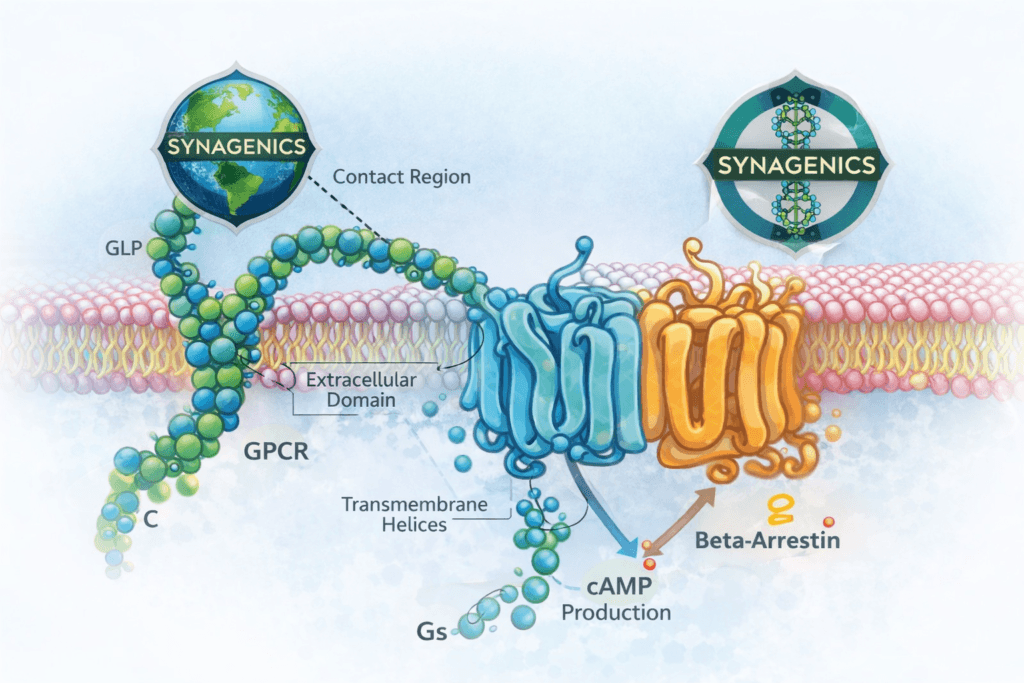
Because GLP receptor systems belong to class B G protein-coupled receptors (GPCRs), peptide recognition frequently involves coordinated interaction between the receptor’s extracellular domain and transmembrane regions. Structural compatibility between ligand and receptor is therefore a key area of laboratory investigation.
Extensive foundational literature on GLP receptor structure and peptide interaction models can be explored through:
PubMed: https://pubmed.ncbi.nlm.nih.gov
Google Scholar: https://scholar.google.com
Secondary Structure & Conformational Dynamics
Beyond primary sequence, peptides may adopt secondary structural tendencies such as alpha-helical segments or flexible coil regions. Conformation in solution can influence how efficiently a peptide stabilizes an active receptor state.
Researchers examining GLP-3RT research peptide may evaluate:
- Helical propensity in solution
- Intramolecular hydrogen bonding
- Solvent interaction patterns
- Flexibility across specific sequence regions
Conformational stability plays a role in receptor activation models. When a peptide maintains structural integrity in solution, receptor-binding interactions may be more predictable and reproducible in laboratory assays.
Structural studies in the GLP receptor field frequently describe a two-domain binding mechanism:
- Initial interaction with the receptor extracellular domain
- Stabilization of active conformations within the transmembrane helices
This interaction model highlights the importance of structural precision in peptide engineering.
Peptide Engineering Strategies in GLP-3RT
Peptide engineering is a controlled process aimed at optimizing structural behavior while maintaining functional receptor interaction characteristics. In GLP-related research peptides, engineering strategies may include:
- Strategic amino acid substitutions
- Modification of cleavage-prone sites
- Structural stabilization motifs
- Terminal region adjustments
- Charge distribution refinement
These approaches are evaluated under laboratory conditions to determine how structural changes affect receptor interaction and signal propagation.
Comparative peptide modeling is commonly performed to analyze differences between GLP-3RT research peptide and related constructs such as:
Comparative structural analysis helps researchers understand how sequence alterations may influence receptor engagement patterns within the GLP peptide family.
GLP-2TZ research peptide:
https://synagenics.com/shop/glp-2tz-tirz/
For laboratory-grade GLP-3RT research peptide:
https://synagenics.com/shop/glp-3rt/
Molecular Weight & Structural Verification
Precise molecular weight confirmation is essential in peptide research. Even small deviations in amino acid composition can alter calculated molecular mass.
Laboratory verification methods typically include:
- High-Performance Liquid Chromatography (HPLC)
- Mass Spectrometry (MS)
- Sequence confirmation techniques
- Purity profiling
HPLC separates peptide material from potential impurities, providing quantitative purity assessment. Mass spectrometry confirms molecular mass alignment with theoretical sequence calculations.
Analytical validation ensures that experimental outcomes reflect true peptide behavior rather than variability introduced by impurities or degradation products.
Synagenics provides access to research peptides verified using these analytical approaches through the primary shop interface:
Structure–Activity Relationship (SAR) Considerations
Structure–activity relationship (SAR) analysis evaluates how molecular changes influence biological interaction patterns. In GLP receptor research, SAR investigations frequently examine:
- Residue-specific substitutions
- N-terminal modification effects
- Receptor activation strength
- Signal duration patterns
- Conformational bias tendencies
While binding affinity is one component of peptide evaluation, activation kinetics and receptor regulation patterns are equally important. Structural features can influence how long a receptor remains active, how rapidly it internalizes, and how intracellular pathways are modulated.
GLP-3RT research peptide may serve as a comparative model within broader GLP receptor investigations aimed at understanding ligand-induced receptor conformational states.
Stability-Oriented Structural Features
Peptide stability is influenced by multiple structural variables, including:
- Sequence length
- Charge distribution
- Susceptibility to enzymatic cleavage
- Solvent exposure
- Oxidation-prone residues
Engineering approaches often attempt to minimize degradation pathways while preserving receptor compatibility. Structural modifications designed to enhance stability are evaluated in controlled laboratory settings using temperature and pH stability assays.
Lyophilization further supports structural preservation by reducing moisture exposure. Additional discussion of stability characteristics can be explored through Synagenics research resources and product documentation:
https://synagenics.com/blog/
https://synagenics.com/what-is-nad/
Structural Comparison Within the GLP Peptide Family
GLP-family research peptides share core structural motifs but may differ in sequence length, residue substitutions, and engineered stabilization features.
| Feature | GLP-3RT | GLP-2TZ | Other GLP Peptides |
|---|---|---|---|
| Primary Focus | Receptor interaction modeling | Comparative GLP pathway research | Sequence-dependent |
| Engineering Strategy | Stability-optimized sequence | Variant sequence design | Variable |
| Format | Lyophilized | Lyophilized | Lab-specific |
| Verification | HPLC & MS | HPLC & MS | Supplier-dependent |
These comparisons are intended to support structural evaluation within laboratory environments. No conclusions regarding functional outcomes are implied.
Analytical Characterization & Quality Standards
Analytical rigor is foundational in peptide research supply. GLP-3RT research peptide undergoes characterization to confirm identity, purity, and structural integrity.
Common quality verification practices include:
- HPLC purity analysis
- Mass spectrometry confirmation
- Batch-level documentation
- Certificate of Analysis (CoA) availability
These measures align with standard laboratory quality expectations and support reproducibility in controlled research settings.
Frequently Asked Research Questions
What defines the molecular structure of GLP-3RT research peptide?
Its primary amino acid sequence, secondary structural tendencies, and engineered stabilization features determine its molecular behavior.
How is structural integrity verified?
Through analytical methods such as HPLC and mass spectrometry.
Why is peptide engineering important?
Engineering allows researchers to evaluate how sequence modifications influence receptor interaction and stability.
Is GLP-3RT intended for medical use?
No. It is supplied strictly for laboratory research purposes.
How does GLP-3RT compare with GLP-2TZ?
They share GLP-family characteristics but differ in structural design and comparative modeling focus.
Where can additional GLP receptor literature be found?
Through PubMed and Google Scholar.
Related Synagenics Resources
GLP-3RT Product Page:
https://synagenics.com/shop/glp-3rt/
GLP-2TZ Research Peptide:
https://synagenics.com/shop/glp-2tz-tirz/
Full Shop:
https://synagenics.com/shop/
Synagenics Blog:
https://synagenics.com/blog/
NAD Research Overview:
https://synagenics.com/what-is-nad/
🔬 GLP-3RT Research Library
Explore the complete GLP-3RT research series:
- GLP-3RT Research Hub (Complete Overview)
- GLP-3RT Research Peptide Overview
- GLP-3RT Molecular Structure & Peptide Engineering
- GLP-3RT Receptor Signaling & GPCR Activation
- GLP-3RT Stability, Lyophilization & Laboratory Storage
Compliance Disclaimer
All information provided on this page is intended for laboratory research purposes only. Not medical advice.