
When researchers receive a vial containing 5 mg of a peptide, the immediate question is often “how many units do I need to draw for my experiment?” Units on a syringe correspond to tiny volumes, and converting a mass of peptide into a specific number of units requires an understanding of both concentration and volume. Unlike medical dosing, research calculations focus solely on creating precise working solutions for experiments. Peptides are biologically active molecules composed of short chains of amino acids, and their effects can occur at very low concentrations. Thus, careful measurement is critical.
This guide walks you through the logic of converting a 5 mg lyophilised peptide into units on a syringe. You will learn how to create a suitable stock concentration, determine the volume that corresponds to a given mass and translate that volume into “units” on a typical insulin or research syringe. The integrated calculator below automates these steps, but understanding the underlying math ensures you can verify the results and adapt to any experimental scenario. As always, these calculations are for research planning only.
What Are Syringe Units?
Syringes used in laboratory research often employ unit markings to represent small volumes. A standard insulin syringe contains 1 mL of fluid and is marked from 0 to 100 units. Because 1 mL = 1 cc and each mL is divided into 100 units, 1 unit equals 0.01 mL. Therefore, drawing 10 units corresponds to 0.10 mL, and 50 units corresponds to 0.50 mL.
Converting a 5 mg peptide into units requires you to first prepare a stock solution. The concentration you choose will determine how many units correspond to a given mass. For example, dissolving 5 mg in 5 mL produces a 1 mg/mL solution. At this concentration, each 10 units (0.1 mL) delivers 0.1 mg of peptide. If you need to deliver 0.5 mg, you would draw 50 units (0.5 mL). By contrast, dissolving the same 5 mg in 2.5 mL yields a 2 mg/mL stock; in this case 0.5 mg occupies only 0.25 mL, or 25 units. Selecting a convenient concentration simplifies subsequent unit conversions.
Understanding Peptide Concentration and Solution Strength
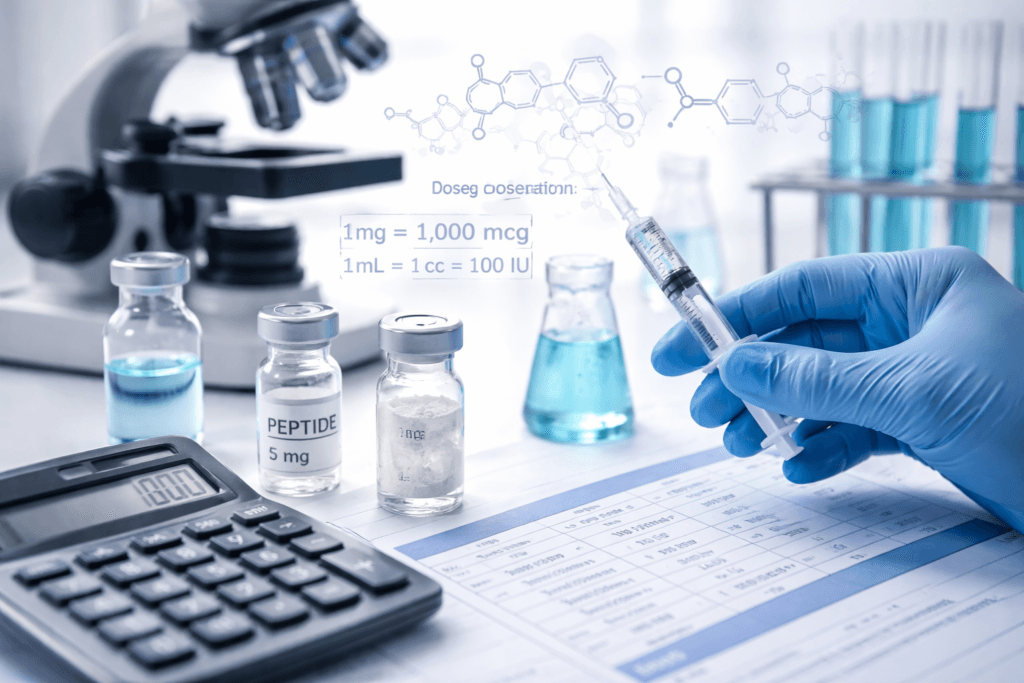
Unit conversions depend on clear mass and volume relationships. Metric conversions state that 1 mg = 1,000 µg and 1 g = 1,000 mg; for volumes, 1 L = 1,000 mL. To relate mg of peptide to syringe units:
- Choose a stock concentration that yields whole-number calculations. A 1 mg/mL stock means each mL contains 1 mg. On a 100-unit syringe, 1 mg is distributed over 100 units, so 1 unit = 0.01 mg = 10 µg.
- Determine the desired mass for your experiment. For example, if your protocol calls for 0.2 mg of peptide, this is 200 µg. With the 1 mg/mL stock, 200 µg occupies 0.2 mL. Since each unit is 0.01 mL, you will draw 20 units.
- Adjust if using a different concentration. If your stock is 2 mg/mL, 1 unit still equals 0.01 mL but each mL contains 2 mg. Therefore, 1 unit delivers 0.02 mg (20 µg). To deliver 200 µg from this stock, you need 10 units.
These principles ensure that the amount of peptide drawn corresponds precisely to the required mass.
The Mathematics Behind Unit Conversion
A few formulas underpin unit calculations:
- Stock concentration (mg/mL). Divide the mass of peptide by the volume of solvent. For 5 mg dissolved in V mL, stock concentration C = 5 mg ÷ V mL. Choose V to produce a convenient C.
- Volume needed for a specific mass. Use the equation V = desired mass ÷ concentration. For example, 0.5 mg ÷ 1 mg/mL = 0.5 mL.
- Units from volume. Since 100 units = 1 mL, multiply the volume (in mL) by 100 to obtain units. Continuing the example, 0.5 mL × 100 units/mL = 50 units.
Researchers often create tables mapping masses to units for a given stock concentration. The integrated calculator below provides this mapping automatically.
Step‑by‑Step Research Preparation Framework
- Reconstitute the peptide. Dissolve your 5 mg peptide in a volume of sterile solvent that yields a practical stock concentration (e.g., 5 mg in 5 mL for 1 mg/mL or in 2.5 mL for 2 mg/mL).
- Define the required mass for your experiment. Review your protocol to determine how many milligrams or micrograms are needed per experimental sample.
- Calculate the volume corresponding to that mass. Use V = mass ÷ concentration. Convert mg to µg if necessary.
- Convert the volume to units. Multiply by 100 to obtain units on a 1 mL syringe. For example, 0.15 mL = 15 units.
- Draw and deliver the volume. Use the syringe to draw the calculated number of units. Ensure the peptide is fully dissolved and mix gently before drawing.
This framework keeps calculations organised and traceable.
Using a Peptide Calculator for Precision
Manual conversions can be error‑prone, especially when dealing with small volumes or different concentrations. A peptide calculator simplifies the process. Enter the mass of peptide (5 mg), the desired stock volume (e.g., 2.5 mL) and the desired dose. The calculator returns the stock concentration, the volume needed for the desired mass and the equivalent number of units. This is particularly valuable when preparing multiple samples or adapting a protocol to different concentrations. Synagenics offers an integrated tool below:
Common Calculation Errors and How to Avoid Them
- Using the wrong syringe type. Not all syringes are divided into 100 units per mL. Verify the markings on your equipment.
- Selecting an inconvenient stock concentration. A stock concentration that yields fractional unit values (e.g., 0.3 units) increases the risk of mismeasurement. Opt for concentrations that produce whole or simple unit values.
- Neglecting to account for dead volume. Syringes and needles have small dead volumes that can trap liquid. When volumes are extremely small, this loss can affect the dose.
- Confusing mg and µg. Always convert masses to consistent units before calculating.
Verifying each step against a calculator helps prevent these issues.
Frequently Asked Research Questions
Do I have to use a 1 mg/mL stock? No. Choose a concentration that simplifies your calculations. For example, 2 mg/mL stock means each 10 units contains 0.2 mg (200 µg).
How many units deliver 100 µg of peptide from a 1 mg/mL stock? A 1 mg/mL stock contains 1,000 µg per mL. 100 µg occupies 0.1 mL. Since 1 mL = 100 units, you would draw 10 units.
What if my syringe has 50 units per mL? Some research syringes are half‑size. Divide the mL volume by the number of units to determine the per‑unit volume. For example, 0.1 mL on a 50‑unit syringe corresponds to 5 units.
Can I reuse stock solutions over several days? To preserve peptide integrity, aliquot and freeze stock solutions. Avoid leaving peptides at room temperature for extended periods.
Is this guidance relevant to therapeutic dosing? No. The information here is strictly for laboratory research. Clinical dosing involves additional pharmacodynamic considerations.
Research & Scientific Literature
Scientific literature underscores the diverse roles of peptides in metabolism and cellular communication. Peptide hormones such as insulin, glucagon and leptin regulate blood glucose, appetite and energy balance, while other bioactive peptides modulate immune functions and inflammatory pathways. Because these molecules exert effects at nanomolar or micromolar concentrations, precise measurement is crucial. Researchers can explore PubMed or Google Scholar for studies on peptide signalling, peptide pharmacokinetics or analytical quantification of peptides to deepen their understanding.
Related Synagenics Resources
- Reconstitution Calculator for determining solvent volumes.
- GLP‑3rt Research Peptide and GLP‑2tz Research Peptide for research applications.
- Shop to source peptides and lab supplies.
- Blog for scientific insights.
- NAD500 and 5‑Amino‑1MQ to learn about other research compounds.
- What Is NAD? for background on nicotinamide adenine dinucleotide.
Compliance Disclaimer
Peptides supplied by Synagenics are for laboratory research use only. Always follow proper laboratory protocols and dispose of materials safely.