
Multi-receptor agonist research design examines how one peptide construct may be developed to engage multiple receptor systems within the same metabolic research framework. This area of peptide research continues to grow because metabolic signaling rarely depends on a single isolated pathway. Instead, incretin-linked activity, glucagon-associated signaling, adipose communication, and intracellular messenger systems often interact within a broader network. As a result, compounds designed for wider receptor engagement can support a more complete view of pathway coordination, signaling balance, and molecular design strategy. Readers exploring this category can continue through the Metabolic Research Hub, the GLP-3RT Research Hub, and Adipose Tissue Signaling Research for additional context.
Rather than simply combining targets into one construct, multi-receptor design focuses on how receptor balance, pathway breadth, structural stability, and exposure profile work together within a single research tool. A well-designed multi-receptor peptide may provide broader value in structured metabolic research because it allows several related signaling systems to be examined within one framework. For customers learning about metabolic peptide categories, this makes product exploration more useful by connecting scientific education with relevant product pathways across the Synagenics collection.
Understanding Multi-Receptor Agonist Research
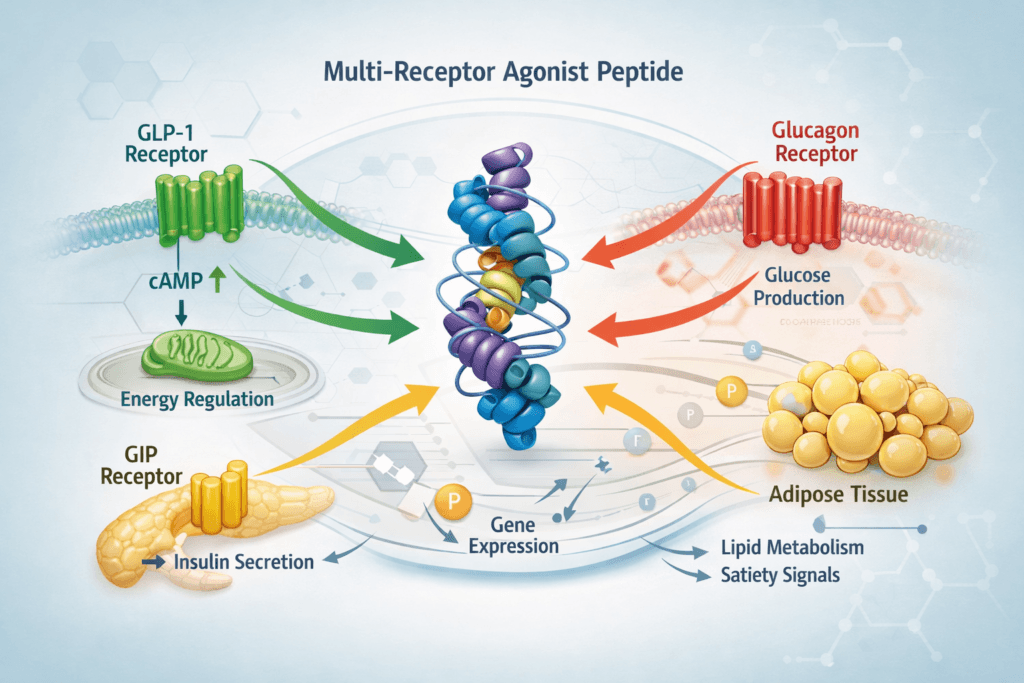
Metabolic peptide research reflects the fact that many signaling systems are interconnected. Receptor pathways associated with incretin biology, glucagon signaling, nutrient-response activity, adipose signaling, and intracellular messengers often influence one another instead of functioning as separate channels. Because of this, multi-receptor agonist design has become an important area of interest for researchers studying broader pathway architecture. Instead of limiting a research model to one receptor at a time, multi-target compounds allow a wider view of how coordinated signaling may develop across related metabolic systems. This broader approach has contributed to growing interest in dual- and triple-agonist research throughout the peptide field. PubMed Citation | Google Scholar
For customers, that broader design approach makes the category easier to understand. It explains why some compounds are described as pathway-focused tools, why receptor-combination research appears so often in the scientific literature, and how a single product can fit into a wider metabolic research conversation. Readers who want a broader overview can continue through the Metabolic Research Hub, where related products and educational topics are organized together.
Key Elements of Multi-Receptor Agonist Design
Receptor Selection and Pathway Scope
The design process begins with receptor selection. In metabolic peptide research, this often includes combinations involving GLP-1 receptor activity, GIP receptor activity, glucagon receptor activity, or broader pathway combinations aligned with specific research goals. Each receptor contributes a different signaling dimension, so combining them within one peptide construct creates a broader research tool than a strictly selective ligand. This is especially useful when the goal is to examine pathway interaction rather than isolated receptor behavior. Reviews on next-generation multi-agonists show how the field has progressed from single-pathway compounds toward molecules designed for coordinated receptor engagement across wider metabolic systems. PubMed Citation | Google Scholar
For customers exploring this space, receptor selection helps explain why products in the same general category may still support different types of pathway research. One compound may be better suited to incretin-focused investigation, while another may align more naturally with broader receptor-interaction work.
Potency Balance and Signaling Profile
A multi-receptor construct is rarely designed to activate every receptor in exactly the same way. Researchers often engineer compounds around a specific signaling balance so that one pathway may show stronger engagement while others provide complementary activity. This balance can influence receptor activation patterns, intracellular messenger behavior, and overall pathway interpretation within metabolic models. As a result, two compounds may both fall within the multi-receptor category while still offering very different research profiles because their receptor balance was designed differently. PubMed Citation | Google Scholar
That design logic is useful for both education and comparison. Instead of viewing a product label as the whole story, customers can better understand the reasoning behind the compound and how that reasoning fits into the broader metabolic peptide category.
Molecular Architecture and Peptide Engineering
Molecular architecture is another major part of multi-receptor agonist design. Researchers often begin with known peptide backbones and then refine the sequence to support receptor engagement, structural integrity, solubility, and overall pathway performance. These sequence-level decisions may influence how a compound is prepared, how it is evaluated, and how effectively it functions as a multi-target signaling tool. Medicinal chemistry work in this area has shown that molecular design can strongly shape how triple agonists perform across several receptor systems, making peptide engineering central to the value of the final construct. Primary Research Example | Google Scholar
This kind of language also strengthens the page itself. It adds topical depth, improves semantic relevance, and gives customers more meaningful context as they move from educational content into product exploration.
Exposure Profile and Research Sequence
Exposure profile also plays a meaningful role in this category. Some metabolic peptides are designed with structural features intended to support a longer research window, while others may fit shorter observation formats. When several receptor systems are involved, exposure behavior can influence how signaling unfolds across time and how pathway coordination is interpreted within the overall research model. This makes exposure design part of the broader engineering strategy rather than a minor supporting detail.
Multi-Receptor Agonists in Metabolic Signaling Research
Metabolic signaling involves overlapping systems rather than one isolated line of communication. Receptor activation may connect with intracellular messenger pathways, endocrine network activity, adipose-related communication, and energy-regulation mechanisms within the same broader framework. Multi-receptor agonist research is valuable because it allows these overlapping systems to be examined with greater integration. Rather than separating each pathway question into a different model, researchers can evaluate how several receptor pathways may interact within one peptide design.
This broader perspective is especially relevant for readers interested in adipose-related research themes. Adipose signaling involves dynamic communication across tissue-level and receptor-level processes, which is why Adipose Tissue Signaling Research complements the receptor-focused discussion here. Together, these topics create a more complete educational framework for customers exploring advanced metabolic peptide categories.
cAMP-Associated Signaling and Downstream Activity
Many receptor systems involved in metabolic peptide research are closely linked to cAMP-associated intracellular signaling. Because of this, multi-receptor agonists are often evaluated not only by receptor engagement, but also by how they influence downstream messenger behavior across several targets. This adds depth to the value of a compound and helps distinguish broader pathway tools from narrower receptor-specific constructs. Customers who want more context around receptor-driven signaling can continue with the GLP-3RT Research Hub, which adds another layer of educational relevance within the Synagenics metabolic category.
Comparing Single-, Dual-, and Triple-Pathway Research Compounds
Single-pathway compounds remain important because they support focused receptor-specific investigation. Dual-pathway constructs expand that focus by bringing two signaling systems into one peptide design. Triple-pathway compounds extend the concept further by combining three receptor targets within the same framework. Each approach supports a different type of pathway question. Some studies benefit from highly selective tools, while others are better served by broader receptor coordination and wider pathway coverage.
For customers, this comparison adds clarity during product exploration. It helps explain why one product may suit a narrower receptor discussion while another may fit more naturally into a wider metabolic pathway conversation. Strong educational language makes the shopping experience more informative, especially when product pages and research hubs are linked together naturally across the site.
Explore Synagenics Metabolic Research Products
Synagenics offers a growing selection of metabolic research products connected with receptor-pathway interaction, adipose signaling, peptide engineering, and multi-target design. For customers who want to learn and browse in one place, the Metabolic Research Hub is a strong starting point for comparing categories and continuing into individual product pages.
Featured Metabolic Research Products
- GLP-3RT
- GLP-2TZ
- Cagrilintide 5mg
- Survodutide
- AOD-9604
- 5-Amino-1MQ 5mg
- Tesamorelin 10mg
- LipoBlaster
- Lipo-CB12
Among these options, GLP-3RT is especially relevant for readers interested in broader receptor-signaling discussions, while products such as Survodutide, Cagrilintide 5mg, and AOD-9604 help expand the wider metabolic category for customers comparing research directions. Linking educational pages, hubs, and product pages in this way also helps visitors move naturally from learning to browsing.
For Research Use Only
All products and educational content on this page are presented for laboratory, analytical, and research purposes only. The information is intended to support scientific learning, category exploration, and informed product browsing within a research-use framework. Product selection should be based on research goals, compound category, documented handling requirements, and overall study design.
Frequently Asked Questions
What is multi-receptor agonist research design?
Multi-receptor agonist research design focuses on how one peptide construct may be developed to engage more than one receptor system within the same metabolic research framework, allowing broader pathway investigation than a single-target design alone.
Why are multi-receptor peptides studied in metabolic research?
They are studied because metabolic signaling often involves overlapping receptor systems rather than a single isolated pathway. Multi-receptor constructs can support broader analysis of coordinated pathway behavior within a structured research model.
How do dual- and triple-pathway compounds differ from single-pathway compounds?
Single-pathway compounds are generally used for more focused receptor-specific work, while dual- and triple-pathway compounds broaden the research scope by combining multiple receptor targets within one molecular design.
Where can I explore Synagenics metabolic research products?
A strong starting point is the Metabolic Research Hub, where readers can review multiple metabolic product categories, educational topics, and related product pages together.
Which pages can help me learn more about receptor-pathway signaling?
The GLP-3RT Research Hub offers additional context around receptor-driven metabolic signaling, while Adipose Tissue Signaling Research expands the discussion into adipose pathway communication.