
Peptides are short chains of amino acids that play pivotal roles in virtually every biological system, acting as hormones, neurotransmitters and signaling molecules. In a research setting, peptides are usually supplied as lyophilised powders that must be reconstituted and measured accurately. Determining how much of a peptide to use requires translating the mass of powder (in milligrams) into a volume of solution (in millilitres) and, in some applications, understanding the unit markings on syringes or pipettes. The aim is to ensure consistency and repeatability across experiments and to avoid wastage of valuable research materials.
Laboratories never follow human dosing protocols when preparing peptides for experiments. Instead, calculations focus on concentrations (mg/mL), volumes and units that make sense for in vitro or in vivo models. This page provides a comprehensive reference and an integrated calculator for those conversions. It explains the fundamental science behind peptide dosage calculations, the mathematics involved in creating working solutions, and the common pitfalls encountered by researchers. All information is presented for laboratory planning only; nothing here should be interpreted as medical guidance.

What Is Peptide Dosage in Research?
In research, “dosage” refers to the mass of peptide that will be present in a given experiment, expressed relative to the volume of solvent used. Peptides themselves are biologically active molecules composed of two or more amino acids held together by peptide bonds. Bioactive peptides can influence metabolism, immune function and cellular communication, and this versatility makes them attractive research tools. Because they are active at very small quantities, their measurement requires careful handling.
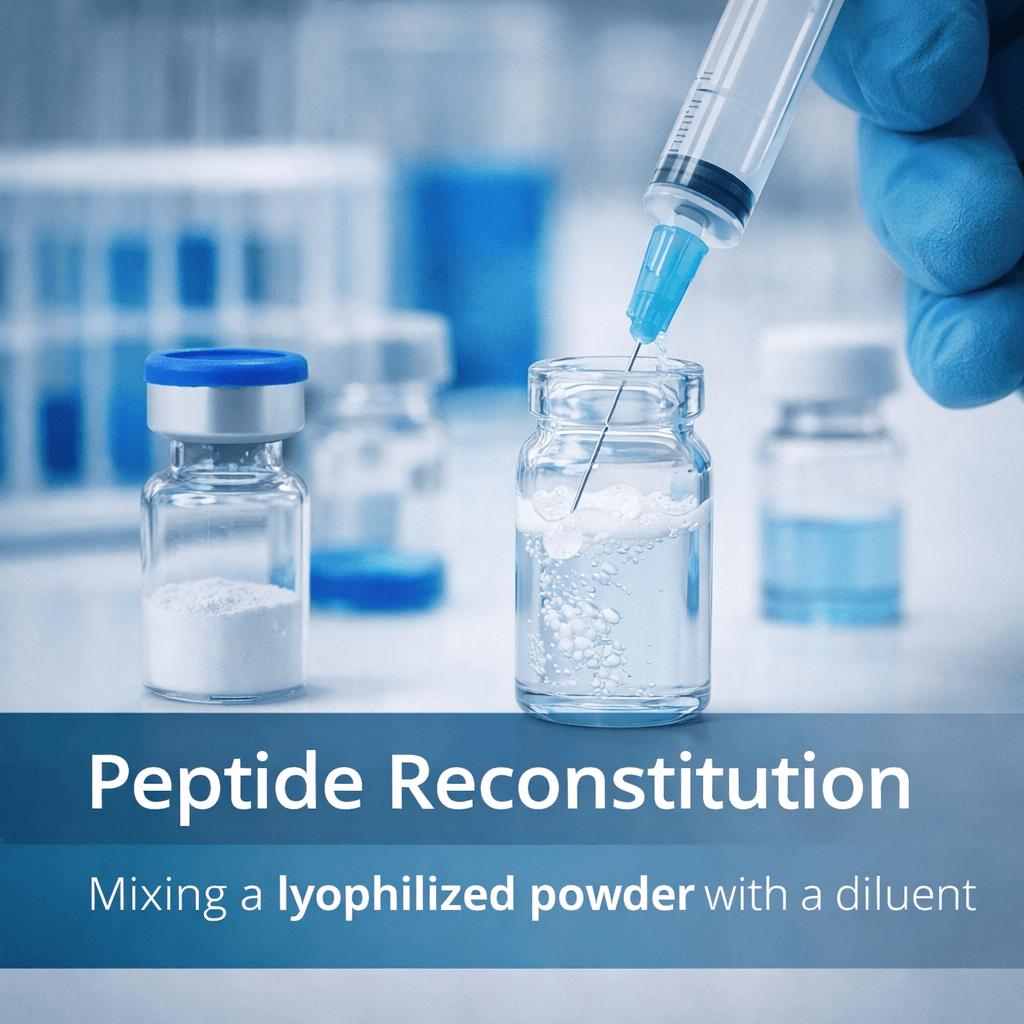
Peptides are typically supplied as lyophilised powders. To use them, researchers dissolve the powder in a suitable solvent (often sterile water) to create a stock solution. The amount of solvent determines the stock concentration (e.g., 2 mg/mL). When a working concentration is required, the stock can be diluted further using the C₁V₁ = C₂V₂ formula, where C₁ and V₁ are the concentration and volume of the stock solution, and C₂ and V₂ are the desired concentration and volume. Unlike pharmacological dosing, research calculations do not consider patient weight or therapeutic doses; they simply translate between mass, volume and concentration.
Understanding Peptide Concentration and Solution Strength
Concentration expresses how much peptide is dissolved per unit of solvent. Conversions between units of mass and volume are essential:
- Mass conversions. Scientific units follow metric relationships: 1 gram = 1,000 milligrams (mg) and 1 mg = 1,000 micrograms (µg). These conversions allow researchers to translate a label that reads “5 mg peptide” into 5,000 µg.
- Volume conversions. 1 litre = 1,000 millilitres (mL) and 1 mL = 1 cc (cubic centimetre). Syringes and micropipettes are marked in millilitres or fractions thereof. Many insulin syringes hold 1 mL and are marked from 0 to 100 “units,” where each unit corresponds to 0.01 mL. Thus, 100 units on a standard insulin syringe equals 1 mL of solution.
- Concentration (mass/volume). A solution labelled 2 mg/mL contains 2 mg of peptide in each mL. To convert to micrograms per millilitre, multiply by 1,000 (2 mg/mL = 2,000 µg/mL). When drawing from this vial with a syringe, 10 units (0.1 mL) would deliver 0.2 mg (200 µg) of peptide.
Understanding these relationships ensures that the right amount of peptide is added to experimental systems. Precise concentration also supports reproducibility across studies.
The Mathematics Behind Peptide Calculations
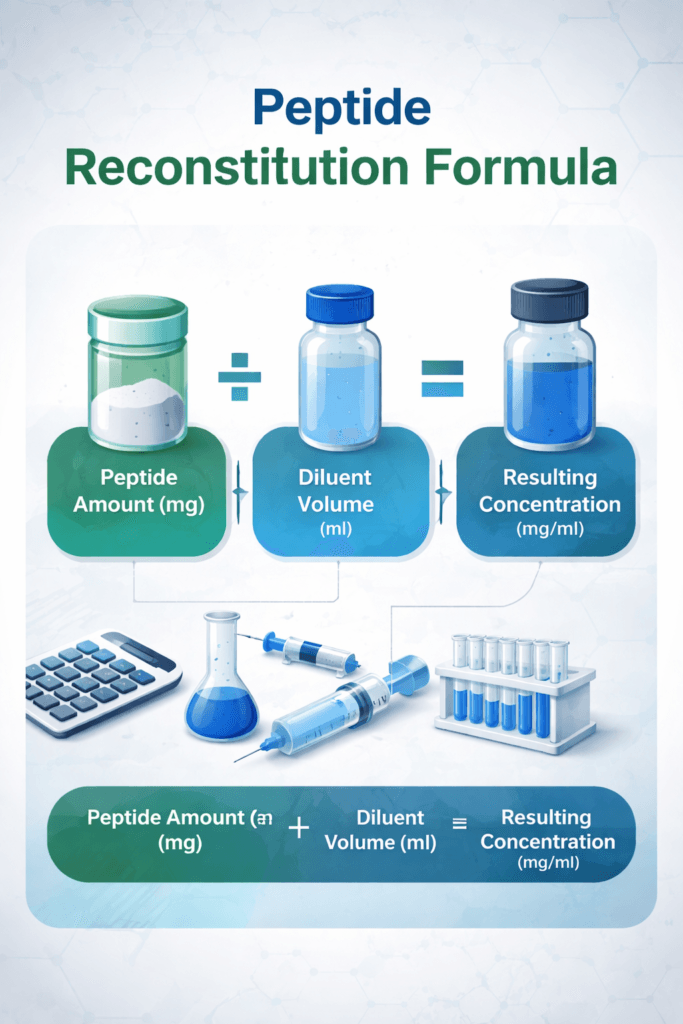
Peptide dosage calculations rely on a few straightforward equations:
- Determining stock concentration. After dissolving a lyophilised peptide, the stock concentration is calculated by dividing the mass by the volume. For example, dissolving a 5 mg vial into 2.5 mL yields a 2 mg/mL solution.
- Dilution calculations (C₁V₁ = C₂V₂). To prepare a working solution from the stock, multiply the stock concentration (C₁) by the volume you intend to withdraw (V₁). That product equals the amount of peptide needed in the final solution (C₂ × V₂). Solving for the unknown term allows you to determine how much stock to use or how much solvent to add. Because reconstitution volumes are small, many researchers use microcentrifuge tubes and micropipettes to measure microlitre quantities.
- Unit conversions for syringes. To translate between mL and syringe units, recognise that a typical insulin syringe holds 1 mL across 100 units. Therefore, 1 unit = 0.01 mL, so a 10 unit volume corresponds to 0.10 mL. Combining this with concentration data yields the mass delivered per unit.
By understanding these formulas, researchers can design experiments with consistent peptide concentrations. Importantly, these calculations do not consider any biological context; they are purely mathematical tools for laboratory preparation.
Step‑by‑Step Research Preparation Framework
- Weigh or verify peptide mass. Confirm the mass of the peptide (e.g., 5 mg) indicated on the vial. Some manufacturers supply peptides pre‑measured.
- Select a solvent. For many peptides, sterile water or buffer is recommended. Always consult the product sheet to determine solvent compatibility.
- Reconstitute to a convenient stock concentration. Choose a volume that yields a simple concentration. For example, dissolving 5 mg in 5 mL yields a 1 mg/mL stock, while 2.5 mL yields 2 mg/mL. Mix gently to avoid foaming.
- Calculate working volumes. Use C₁V₁ = C₂V₂ to determine how much stock to transfer to achieve the desired experimental concentration. If the final mixture requires 100 µg of peptide in 1 mL, and your stock is 1 mg/mL, then V₁ = (100 µg ÷ 1,000 µg/mL) = 0.1 mL.
- Aliquot and store. Dividing the stock into small aliquots minimises freeze‑thaw cycles and maintains stability. Store according to manufacturer guidelines (often at −20 °C or −80 °C).
Following a structured workflow minimises errors and preserves peptide integrity. Always document volumes and concentrations to support reproducibility.
Using a Peptide Calculator for Precision
Modern peptide calculators automate the conversions described above. By entering the mass of your peptide and the desired concentration, a calculator instantly outputs the volume of solvent required. If you know the stock concentration, it can convert micrograms to syringe units, ensuring you draw the correct amount. Using a calculator reduces transcription errors, particularly when handling microgram quantities or converting between units. Synagenics provides an integrated tool for these calculations
Common Calculation Errors and How to Avoid Them
- Mixing up milligrams and micrograms. Confusing mg and µg can lead to 1,000‑fold errors. Always convert to consistent units before calculating.
- Misreading syringe units. Remember that a standard insulin syringe has 100 units per mL. Using a syringe with different graduations can change the volume delivered per unit.
- Incorrect dilution math. Double‑check C₁V₁ = C₂V₂ calculations, and keep track of which variable represents stock versus working solution.
- Assuming a solution is homogeneous. Ensure peptides are fully dissolved before aliquoting; undissolved material can lead to concentration variability.
Careful attention to units and math will prevent these issues and support consistent results.
Frequently Asked Research Questions
What concentration should I choose for my stock solution? Many researchers choose round numbers (e.g., 1 mg/mL or 2 mg/mL) because they simplify calculations. Select a concentration that suits your experimental needs and avoids extremely small pipetting volumes.
How do I convert mg of peptide into syringe units? Determine your stock concentration (e.g., 2 mg/mL). Because 1 mL equals 100 units on a standard insulin syringe, divide the desired mass by the concentration and then multiply by 100 to obtain units. For instance, delivering 0.2 mg from a 2 mg/mL solution requires 0.1 mL, which is 10 units.
Can I reuse a reconstituted peptide after multiple freeze–thaw cycles? Repeated freeze–thaw cycles can degrade peptides. To maintain stability, aliquot your stock into small volumes and thaw only what you need for each experiment.
Why is accurate dosing so important? Peptides can be biologically active at low concentrations. Inaccurate measurements can cause variability in cell responses and compromise reproducibility.
Is this calculator intended for clinical dosing? No. All calculations and examples here are strictly for research planning. Nothing in this guide should be used for clinical or veterinary purposes.
Research & Scientific Literature
Peer‑reviewed literature emphasises the importance of peptides in biological systems. Peptides serve as hormones, growth factors and neurotransmitters, and they regulate numerous physiological processes. Bioactive peptides can modulate immune responses, metabolic pathways and cell signalling, making them valuable tools for research and drug discovery. The precise roles and mechanisms of peptides are the subject of ongoing research, and accurate laboratory preparation is essential to explore these functions.
For further reading, researchers can search PubMed or Google Scholar for topics such as “peptide signalling pathways,” “peptide hormone research,” or “bioactive peptides in metabolism.” Accessing literature through these databases ensures you consult peer‑reviewed sources.
Related Synagenics Resources
For additional calculators and reference materials, explore these Synagenics pages:
- Synagenics Reconstitution Calculator – an interactive tool to determine solvent volumes for various peptide masses.
- GLP‑3rt Research Peptide and GLP‑2tz Research Peptide – explore the properties of these glucagon‑like peptides.
- Synagenics Shop – browse additional research peptides and reagents.
- Synagenics Blog – read in‑depth articles on laboratory techniques and peptide science.
- NAD500 and 5‑Amino‑1MQ Metabolic Research – learn about related compounds used in metabolic research.
- What Is NAD? – discover how nicotinamide adenine dinucleotide contributes to cellular energy metabolism.
Compliance Disclaimer
All information provided on this page is intended for laboratory research use only. Peptides supplied by Synagenics are not for human or veterinary use. They should be handled by trained personnel in appropriate facilities and used solely in accordance with approved research protocols.