

Expert overview
What are peptides? Structure, synthesis, characterization and research uses
Peptides are short chains of amino acids that sit between single amino acids and full proteins. This guide explains what they are, how they are named and built, how researchers characterize them, and how to judge the quality of a research peptide.
Research peptide quality guideBrowse certificates of analysis
Key takeaways
- A peptide is a chain of two or more amino acids joined by peptide bonds, usually up to about 50 residues.
- Most research peptides are made by solid-phase synthesis, purified by HPLC and identified by mass spectrometry.
- Purity and identity answer different questions, so a useful certificate reports both.
- Net peptide content tells you how much of the powder is actually peptide.
- Research peptides are laboratory materials, not drugs, supplements or cosmetics.
Updated November 2026 by the Synagenics research team. For laboratory research use only.
Peptides at a glance
The short version, before the detail.
| Definition | A chain of two or more amino acids joined by peptide bonds |
|---|---|
| Typical length | From 2 to about 50 amino acids; longer chains are generally called proteins |
| Building blocks | The 20 standard amino acids, plus modified and non-natural residues in synthetic peptides |
| Reading direction | From the N-terminus (free amino group) to the C-terminus (free carboxyl group) |
| Typical mass | From a few hundred to a few thousand daltons |
| Usual manufacture | Solid-phase peptide synthesis followed by HPLC purification |
| Standard characterization | HPLC for purity, mass spectrometry for identity |
What is a peptide?
A peptide is a molecule made of amino acids linked in a chain. Each link is a peptide bond, formed when the carboxyl group of one amino acid reacts with the amino group of the next, releasing a molecule of water. The result is a backbone with a repeating pattern and a series of side chains that give each peptide its identity.
The word covers a wide range. A dipeptide has two amino acids, a tripeptide three, and an oligopeptide a handful more. A polypeptide can have dozens. There is no strict boundary between a long peptide and a small protein, but a common working cutoff is around 50 amino acids, or a mass of roughly 5,000 daltons.
What distinguishes peptides in practice is that they are small enough to be made reliably by chemical synthesis. That makes them precise research tools: a chemist can specify the exact sequence, and a laboratory can compare lots by mass and purity.

The peptide bond and sequence notation
The peptide bond is a covalent link between a carbonyl carbon and an amide nitrogen. It is planar and fairly rigid, which limits how a chain can fold and is a reason peptide structure is predictable enough to study.
Sequences are written from the N-terminus to the C-terminus. Amino acids are shortened to three-letter codes, such as Gly, His and Lys, or to single letters, such as G, H and K. A tripeptide of glycine, histidine and lysine is therefore written Gly-His-Lys or GHK. That ordered list is the peptide’s primary structure, and changing a single letter creates a different molecule.
Free peptides have a free amino group at one end and a free carboxyl group at the other. Synthetic chemists often modify one or both ends, a point covered below.
Peptides by size
Names change with the number of amino acids, though the boundaries are conventions rather than rules.
Dipeptides and tripeptides
Two or three amino acids. Examples include the dipeptide carnosine and the tripeptides glutathione and GHK.
Oligopeptides
Roughly four to ten amino acids. Short synthetic sequences used as assay substrates and standards fall here.
Polypeptides and small proteins
From about ten to fifty residues or more. Hormones such as insulin, at 51 amino acids across two chains, sit at the boundary.
Peptides in nature
Peptides occur throughout biology. Glutathione is a tripeptide found in nearly all cells. Oxytocin and vasopressin are nine-residue peptides. Insulin is a 51-residue protein hormone made of two peptide chains. Many toxins, antibiotics and signaling molecules are peptides too.
This biological variety is one reason peptides attract research interest, but it also means that natural examples differ enormously in size, structure and behavior. Studying one peptide tells you little about another unless the sequences and conditions are comparable, which is why precise identification of every reagent matters.
A short history of peptide science
The idea that amino acids join into chains is more than a century old. In 1902 the chemist Emil Fischer proposed the peptide bond and gave peptides their name, and the decades that followed turned that idea into a working discipline.
- 1953, the first synthetic peptide hormone. Vincent du Vigneaud and colleagues made oxytocin in the laboratory, work recognized with the 1955 Nobel Prize in Chemistry.
- 1950s, the first full sequence. Frederick Sanger worked out the amino acid sequence of insulin, which showed that a protein has a defined, readable structure. He received the 1958 Nobel Prize in Chemistry.
- 1963, solid-phase synthesis. Bruce Merrifield anchored the first amino acid to an insoluble resin and built the chain one residue at a time. The method, honored with the 1984 Nobel Prize in Chemistry, is still the basis of peptide manufacture.
- 1970s onward, Fmoc chemistry. Milder protecting groups made routine synthesis of longer and more complex sequences practical.
- Today, routine mass spectrometry. LC-MS lets a laboratory confirm the mass of a peptide in minutes, so identity can be checked on every lot.
The thread through all of this is control. Each advance gave chemists a more precise way to specify a sequence and a more reliable way to prove they had made it.
How synthetic peptides are made
Most research peptides are made by solid-phase peptide synthesis, developed by Bruce Merrifield, who received the 1984 Nobel Prize in Chemistry for it.
Anchor the first residue
The C-terminal amino acid is attached to an insoluble resin bead.
Build the chain
Protected amino acids are added one at a time, with a deprotection step between each addition.
Cleave from the resin
A strong acid releases the finished chain and removes side-chain protecting groups.
Purify
Preparative reversed-phase HPLC separates the target from deletion sequences and by-products.
Freeze-dry
Pure fractions are lyophilized to a stable solid powder.
Characterize
Analytical HPLC and mass spectrometry confirm purity and identity.
Common peptide modifications
Synthetic chemistry allows changes that nature does not make easily. Researchers use modifications to improve stability, add detection handles or probe how structure relates to behavior.
- N-terminal acetylation and C-terminal amidation remove the terminal charges and make a peptide resemble an internal segment of a larger protein.
- Cyclization joins the two ends or links side chains, restricting the shape of the molecule.
- D-amino acid substitution replaces a natural residue with its mirror image, usually to resist enzymes.
- Labeling attaches a fluorophore or biotin for detection and pull-down experiments.
- Lipidation and PEGylation attach a fatty acid or polyethylene glycol chain to change solubility and stability.
Peptides, proteins and small molecules compared
Peptides occupy a middle ground in size and in how they are made.
Small molecules
Usually under 500 daltons, made by conventional organic synthesis, with defined three-dimensional shapes and few repeating units.
Peptides
Roughly 200 to 5,000 daltons, made by stepwise chemical synthesis, often flexible and sequence-defined.
Proteins
Typically above 5,000 daltons, usually made in cells, folded into complex three-dimensional structures.
How peptides are characterized
No single method tells the whole story. Laboratories combine several.
| Reversed-phase HPLC | Separates the peptide from related impurities and reports chromatographic purity |
|---|---|
| Mass spectrometry | Confirms the molecular mass and therefore the identity of the peptide |
| Amino acid analysis | Reports composition and net peptide content |
| Circular dichroism | Reports secondary structure content in solution |
| NMR spectroscopy | Provides atomic-level structural information for suitable peptides |
| Endotoxin and sterility testing | Checks biological contaminants relevant to cell-based work |
How researchers use peptides in the laboratory
- Assay standards and substrates. Defined sequences calibrate instruments and test enzyme activity.
- Binding studies. Peptides are used to map which part of a protein interacts with a partner.
- Antibody production and epitope mapping. Short sequences stand in for regions of a larger protein.
- Cell culture experiments. Chemically defined peptides can be varied one residue at a time to test which part of a sequence matters.
- Structural biology. Peptides serve as models for folding, aggregation and metal binding.
For worked examples with documentation standards, see our guides to GHK-Cu, Epitalon and Semax, and the Cellular Research Hub.
How peptides act: receptors, signaling and mechanisms
Most of what makes a peptide interesting to researchers comes down to one question: what does it bind, and what happens next? Because peptides are short, flexible chains, their shape can fit a surface the way a key fits a lock. The published literature describes a handful of recurring mechanisms.
- Receptor binding. Many signaling peptides act on G protein-coupled receptors (GPCRs), the largest family of cell-surface receptors. Binding changes the receptor shape and starts an intracellular cascade. Oxytocin and vasopressin are classic examples, each acting through its own GPCR. Laboratories study these interactions with cell-based signaling assays, which are covered in our GPCR signaling assay hub.
- Second messengers. After a receptor is engaged, cells often relay the signal through small molecules such as cyclic AMP or calcium. Researchers measure these readouts to compare how strongly and how selectively different peptides activate a pathway.
- Enzyme interactions. Some peptides act on enzymes rather than receptors. A peptide can slow the breakdown of other signaling molecules, or it can serve as a substrate that enzymes cut into active pieces. Studies of peptide breakdown by proteases are a large field of their own.
- Metal and cofactor binding. A few short peptides bind metal ions. GHK-Cu is the well-known example, a tripeptide that carries copper, and published work examines how that complex behaves in cell culture. See the GHK-Cu research overview.
- Membrane interactions. Antimicrobial peptides such as LL-37 are studied for how they interact with cell membranes, which depends on their charge and on how they fold when they meet a lipid surface.
- Gene expression signaling. Cell and animal studies have examined whether certain short peptides change the expression of particular genes. Published work on Epitalon and Semax falls in this area.
Two features shape every one of these mechanisms. The first is selectivity: a small change in sequence can move a peptide from one receptor to a close relative. The second is half-life: peptides are cut by proteases, so researchers often study modified forms, such as those with D-amino acids, cyclized backbones or end-capping, to see how structure affects stability and signaling.
These mechanisms come from cell-culture and animal studies in the published literature. Synagenics supplies peptides as laboratory research materials only, and nothing here describes a use in people or animals. To go deeper, see the Cellular Research Hub and the Metabolic Research Hub.
How peptide stability is assessed
A peptide is only as useful as the intact molecule that reaches the experiment. Chemists therefore study the ways a peptide can change, and they build analytical methods that can see the changes.
- Oxidation. Methionine, cysteine and tryptophan side chains can oxidize. Oxidized methionine adds 16 Da to the mass, which a mass spectrum can resolve.
- Deamidation. Asparagine and, more slowly, glutamine can lose an amide group, shifting the mass by about 1 Da and changing the retention time.
- Hydrolysis. Peptide bonds can cleave, and some sequences, such as those containing aspartic acid next to proline, are more prone to it than others.
- Aggregation. Some sequences associate into larger assemblies that behave differently in solution and can complicate analysis.
- Racemization. A residue can flip from the L to the D form, producing an impurity that has the same mass as the target.
To catch these changes, analysts use stability-indicating HPLC methods, which separate the intact peptide from its degradation products, and pair them with mass spectrometry to identify what each new peak is. Forced-degradation studies, in which a peptide is deliberately stressed, show which products a method can resolve.
Net peptide content and counter-ions
A vial of lyophilized peptide holds more than peptide. Purification by reversed-phase HPLC usually leaves the peptide as a salt, most often with trifluoroacetate as the counter-ion, and the powder also holds some bound water. The result is that the mass on the label is not the same as the mass of peptide.
Net peptide content is the fraction of the powder that is actually peptide. It can be estimated by amino acid analysis or by elemental nitrogen determination. For a short peptide with several charged residues, the counter-ion can account for a large share of the mass. A researcher who calculates a stock concentration from the powder weight alone can overshoot the true concentration, so it pays to know the net content where it is available and to say how a concentration was calculated when reporting results.
HPLC purity answers a different question. It tells you what fraction of the peptide-related signal belongs to the main peak, not how much of the powder is peptide. Both numbers matter, and a good certificate of analysis makes clear which one it reports.
Judging the quality of a research peptide
Because peptides are made step by step, impurities are a certainty rather than a possibility. Deletion sequences, truncated chains and oxidized forms all arise naturally during synthesis. Purification removes most of them, and analysis shows what remains.
Three questions cover most of what matters. Is the identity confirmed, by mass spectrometry? Is the purity measured, by HPLC, with the chromatogram available? And can the report be matched to the lot you received? A supplier that answers all three with data is giving you something you can check. Our Research Peptide Quality, Testing and COA Guide explains each test, and our public COA library shows real examples.
Explore peptide research by compound
The ideas above show up in every compound page on this site. Each one pairs a research overview with the lot-level data for a specific material.
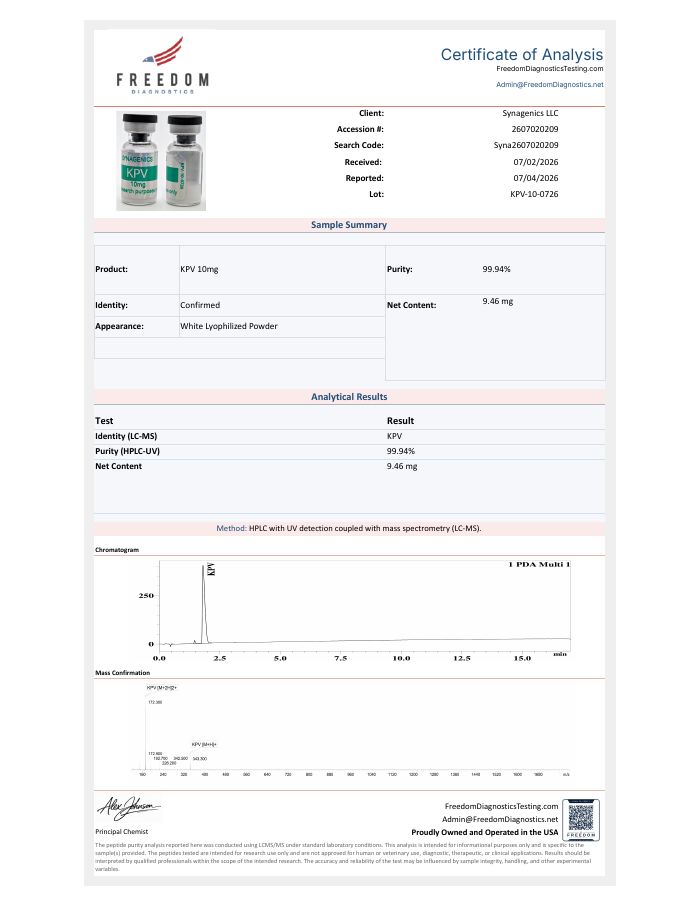
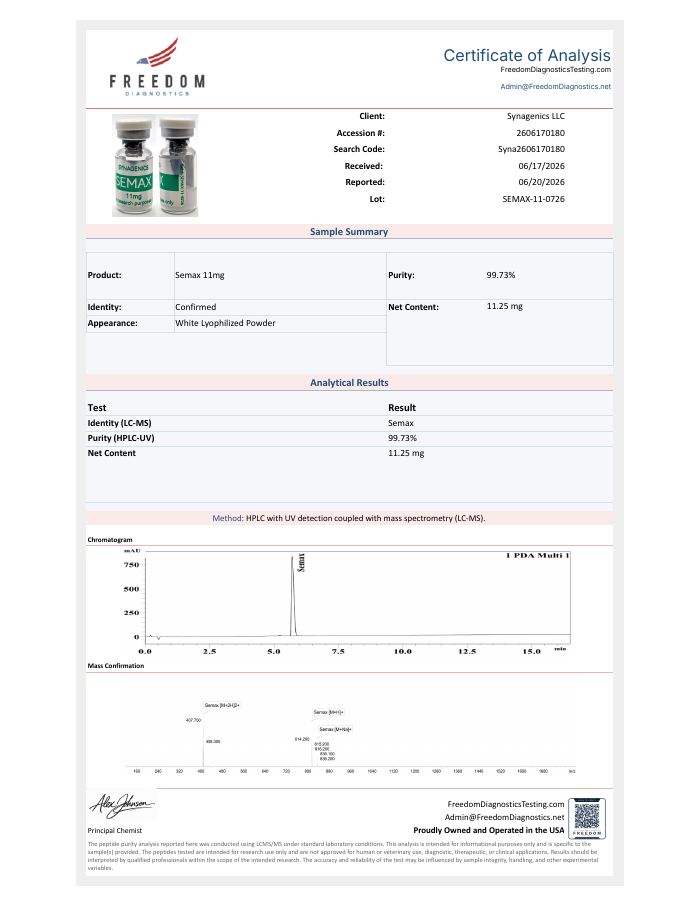
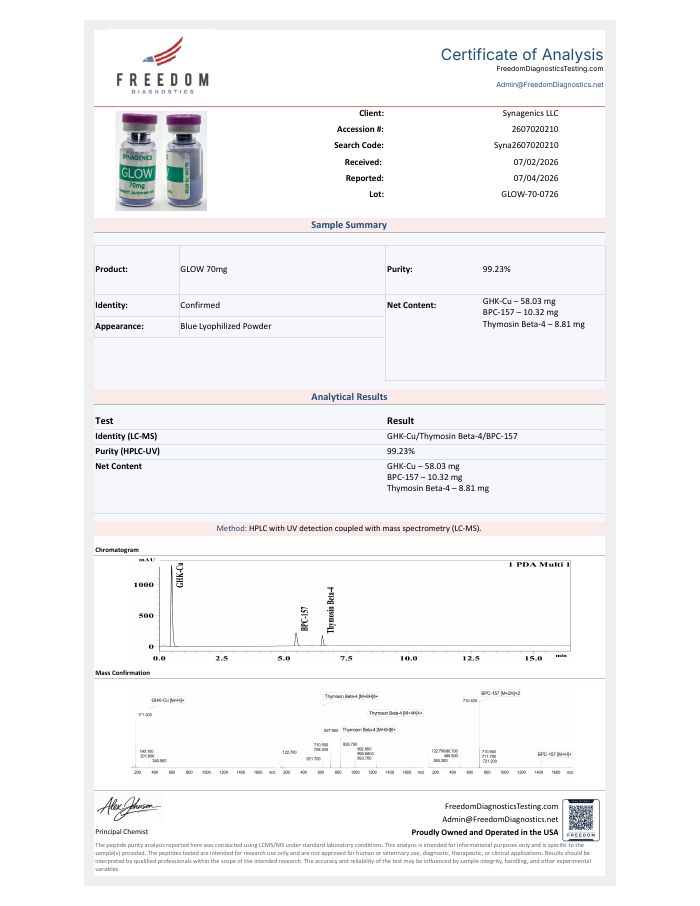
- Research guides. Read the GHK-Cu guide, the Semax guide and the Epitalon guide for chemistry, model systems and experimental design.
- Compound pages. See the data for GHK-Cu, Semax, KPV and the GLOW research blend.
- Hubs. The Research Peptide Quality Guide explains testing in depth, and the Cellular Research Hub covers cell culture design.
- Proof. Every certificate sits in the COA library, and From Our Lab shows how each lot is documented.
Glossary
| Amino acid | The monomer unit of peptides and proteins, with an amino group, a carboxyl group and a side chain |
|---|---|
| Peptide bond | The covalent amide link joining two amino acids |
| N-terminus | The end of the chain with a free amino group |
| C-terminus | The end of the chain with a free carboxyl group |
| Lyophilization | Freeze-drying to produce a stable powder |
| Counter-ion | The salt ion, such as trifluoroacetate or acetate, that accompanies a purified peptide |
| Net peptide content | The percentage of the powder that is peptide rather than counter-ion and water |
| RUO | Research use only |
Common misconceptions about peptides
- “Higher purity means the right compound.” Purity measures how much of the main peak is present. Only mass spectrometry confirms that the main peak is the intended peptide.
- “A peptide and a protein are the same thing.” They share the same chemistry, but size, folding and manufacture differ greatly.
- “All powder is peptide.” A lyophilized powder also contains counter-ion and bound water, so net peptide content is often 60 to 90 percent.
- “Short peptides are simple.” Even a tripeptide can bind metals, oxidize or form multiple species, which is why analysis matters.
- “A certificate is a certificate.” A bare number without a chromatogram, mass spectrum and lot match cannot be verified.
Keep reading: cellular peptide research overview, mitochondrial membrane targeting research, telomere regulatory peptide research, NAD+ pathway research, glutathione antioxidant research, CJC-1295 and Ipamorelin and 5-Amino-1MQ.
Peptides FAQ
Who invented solid-phase peptide synthesis?
Bruce Merrifield introduced solid-phase peptide synthesis in 1963 and received the 1984 Nobel Prize in Chemistry for it. The chain is built one residue at a time on an insoluble resin.
How is peptide stability tested?
Analysts use stability-indicating HPLC methods that separate the intact peptide from degradation products, paired with mass spectrometry to identify each new peak. Forced-degradation studies show which changes a method can detect.
What is net peptide content?
It is the fraction of a lyophilized powder that is peptide, as opposed to counter-ion and bound water. It differs from HPLC purity and matters when calculating concentrations.
What is a peptide?
A peptide is a chain of two or more amino acids linked by peptide bonds. Chains longer than about 50 amino acids are usually called proteins.
How are peptides different from proteins?
Peptides are shorter, typically under about 5,000 daltons, and can be made reliably by chemical synthesis. Proteins are larger, usually made in cells and folded into complex structures.
How are research peptides made?
Most are made by solid-phase peptide synthesis, purified by preparative HPLC and freeze-dried to a stable powder.
How is the purity of a peptide measured?
By reversed-phase HPLC, which separates the target peptide from related impurities. The purity percentage is the main-peak area divided by the total detected peak area.
What does a mass spectrum show?
It shows the molecular mass of the peptide, which should match the theoretical mass calculated from its sequence and so confirms identity.
Are Synagenics peptides for human or animal use?
No. Synagenics supplies peptides strictly for qualified laboratory research. They are not drugs, supplements or cosmetics.
Where can I see Synagenics testing data?
In the public Certificate of Analysis library at synagenics.com/coas/, searchable by compound or lot number.
What does net peptide content mean?
It is the share of a lyophilized powder that is peptide, as opposed to counter-ion and bound water. It is needed to calculate accurate concentrations.
Further reading from primary sources
These are the authoritative sources behind the history and conventions described above.
Related research
Continue exploring the Synagenics research library.
See how we document every lot
Browse the public COA library to read chromatograms and mass spectra before you order.
Research peptide quality guideBrowse certificates of analysis
For qualified laboratory research use only. Not for human or animal use. These statements have not been evaluated by the US Food and Drug Administration.
