

Research peptide blend
GLOW 70 mg research blend, lyophilized, over 99% HPLC purity
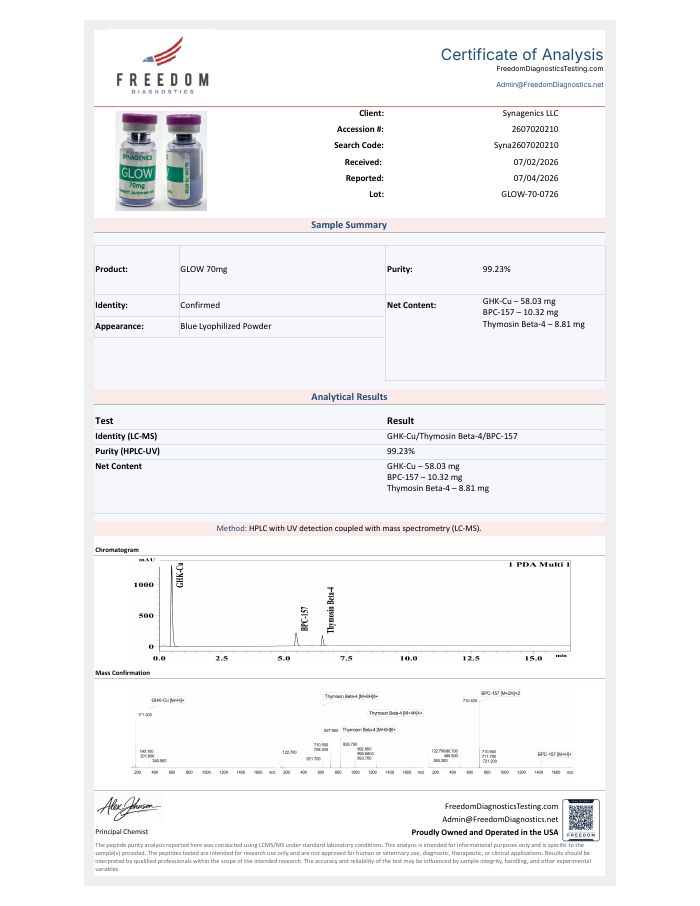
Synagenics GLOW is a lyophilized research blend of GHK-Cu, BPC-157 and TB-500 supplied for qualified laboratories. The certificate of analysis for lot GLOW-70-0726 reports 99.23% HPLC purity with identity confirmed by LC-MS, and the full report is public.

GLOW product data
Identifying details researchers confirm before ordering.
| Product | GLOW 70 mg research blend |
|---|---|
| Components | GHK-Cu, BPC-157 and TB-500 (listed as thymosin beta-4 on the certificate) |
| Supplied amount | 70 mg total per vial |
| Form | Lyophilized powder |
| Purity (HPLC) | Over 99%; 99.23% on lot GLOW-70-0726 |
| Identity (LC-MS) | Confirmed on lot GLOW-70-0726 |
| COA reported | July 4, 2026 |
| GHK-Cu | Copper complex of the tripeptide Gly-His-Lys, CAS 89030-95-5 |
| BPC-157 | Fifteen-residue synthetic peptide, CAS 137525-51-0 |
| Grade | Research use only (RUO) |
About Synagenics GLOW
GLOW combines three peptides that each have a long history in laboratory literature. GHK-Cu is a small copper-binding tripeptide. BPC-157 is a synthetic fifteen-residue peptide. TB-500 is the name used for a synthetic peptide related to thymosin beta-4. Supplying them together lets a laboratory work from one lot-tracked vial when an experiment calls for all three.
Because the vial holds a blend, documentation matters more than usual. For background on each component, read our GHK-Cu research guide, and for how to read purity and identity data, see the Research Peptide Quality, Testing and COA Guide.
What comes with every order
Documentation is part of the product.
Lot-tracked vial
The lot number is printed on the vial, so it matches the certificate in the public library.
Published certificate
HPLC chromatogram and purity, LC-MS identity and the report date, open to read before you order.
Research-use labeling
Clear RUO labeling on every vial, with no claims about people or animals.
Check the data before you order
You can verify our GLOW without an account.
Open the COA library
Go to synagenics.com/coas/ and find the GLOW 70 mg report.
Read the chromatogram
Look at the peak pattern and baseline. The reported HPLC purity is 99.23%.
Check the identity
LC-MS confirms the identity of the material in the vial.
Match the lot
Confirm the lot number on your vial matches GLOW-70-0726 or the lot named on the report you are shown.
Laboratory research applications
The three components appear in the literature across in vitro and biochemical settings. These describe model systems, not any use beyond the bench.
- Cell culture models. Fibroblast, endothelial and other cell lines, with matched vehicle controls for each condition.
- Cell migration assays. Scratch and transwell assays that compare the blend with each single component.
- Copper-binding chemistry. Spectroscopic and chromatographic work on the GHK-Cu copper complex.
- Peptide stability assays. LC-MS or HPLC tracking of each component in buffer or serum-containing medium.
- Analytical method development. A three-component mixture as a test case for resolution and mass accuracy.
General design guidance and controls are in the Cellular Research Hub.
Why blends need careful analysis
A single peptide gives one main chromatographic peak and one expected mass. A blend gives several, each with its own retention time, response and mass. A purity figure for a blend therefore depends on how the report calculated it, so it is worth reading the method and the chromatogram instead of relying on the headline number.
Identity is the other half. LC-MS separates the mixture and then measures the mass of what elutes, which lets a reviewer check that each intended component is present. When you open the GLOW certificate, compare the peaks in the chromatogram with the masses reported, and keep the lot number with your records so any later question can be traced to a specific report.
Plan your purchase for the whole study
- Estimate total need. Calculate how much blend the full study will consume, including repeats, and allow a margin.
- Prefer one lot. Where practical, source the study from a single lot and record the lot number with every dataset.
- Account for net peptide content. Powder mass includes counter-ion and bound water, so concentrations calculated from weight alone can be too high.
- Use component controls. Single-component arms next to the blend show which effects come from the mixture and which from one peptide.
- State the medium. Serum contains peptidases, so record the serum percentage and consider a serum-free condition.
How to compare blend suppliers
Blend product pages look alike. The documentation is what differs.
| Lot-specific certificate | A report that names the exact lot you will receive, not a generic sheet. |
|---|---|
| Full chromatogram | The trace itself, not only a percentage. |
| Identity by mass spectrometry | Masses that match the intended components of the blend. |
| Independent testing | Third-party data rather than a self-issued report. |
| Stated composition | A clear list of the components in the vial. |
| Research-use language | A supplier that implies use in people is not operating as a research supplier. |
Responsible purchasing for research
Synagenics supplies GLOW to qualified laboratories and researchers for laboratory use only. Buyers are responsible for using the material lawfully and in line with their institution’s procurement, safety and ethics policies. The product is not a drug, supplement or cosmetic, and nothing on this page is a claim about use in people or animals.
Questions? Email support@synagenics.com. To learn how we test every lot, read Setting the Standard at Synagenics and From Our Lab.
Key takeaways for GLOW buyers
- Read the chromatogram and the mass data together: purity and identity answer different questions.
- For a blend, check how the report calculated purity across the mixture.
- Match the lot on your vial to the certificate before you use it.
- Calculate concentrations from net peptide content where it is available.
- Use GLOW strictly for laboratory research, within your institution’s policies.
GLOW in context: why researchers compare blends with single peptides
A multi-component material answers a different question from a single peptide. When three peptides are present together, any result could come from one of them, from a combination, or from an interaction in the medium. The only way to tell is to run the single components alongside the blend, at matched concentrations, and compare.
That design also keeps the analysis honest. Each peptide has its own stability in culture, its own mass and its own retention behavior, so measuring the intact components at the start and end of an incubation shows what the cells actually saw. Reporting the lot number and the medium alongside the data lets another laboratory repeat the work.
Designing a clean in vitro experiment with GLOW
- Pick the right controls. Use a vehicle control and single-component arms for GHK-Cu, BPC-157 and TB-500.
- Measure the intact components. Use LC-MS or HPLC to confirm what remains at the end of the incubation.
- Mind the copper. GHK-Cu carries copper, so use a copper-matched control and record the medium composition.
- Standardize the cells. Hold passage number, plating density and culture conditions constant across arms.
- Define the endpoint in advance. Decide the readout, the time points and the statistical test before you start.
- Record the lot. Keep the lot number with every dataset so the work can be repeated.
Understanding the numbers on the GLOW certificate
The certificate for lot GLOW-70-0726 reports a purity of 99.23% by HPLC. That figure reflects the integrated peak areas in the chromatogram for this blend. It does not say how much of the powder is peptide, which is why net peptide content is a separate question when you calculate a stock concentration.
The identity result comes from LC-MS, which measures the mass of what elutes from the column, and the report confirms identity for the material tested. Open the report in the COA library and compare the chromatogram and the mass data yourself. New lots are tested the same way, and purity is expected to stay over 99%.
Common questions researchers ask before using GLOW
- How stable are the peptides in my medium?. Measure it. Serum peptidases vary by lot, so confirm the intact peptides by LC-MS at the end of the incubation.
- Do I need a serum-free control?. It is a useful comparison, because it separates peptide stability from peptide activity.
- Should I run the components separately?. Yes. Single-component arms are the cleanest way to attribute any result.
- What should I record?. The lot number, the net peptide content used for concentration, the medium, the serum percentage and the incubation time.
Our Cellular Research Hub covers cell culture design in more depth.
Buying GLOW for research: FAQ
What is Synagenics GLOW?
It is a 70 mg lyophilized research blend of three peptides: GHK-Cu, BPC-157 and TB-500.
Is GLOW sold for human or animal use?
No. It is sold strictly for qualified laboratory research. It is not a drug, supplement or cosmetic, and nothing on this page is a claim about use in people or animals.
What purity does the GLOW certificate report?
The certificate for lot GLOW-70-0726 reports 99.23% purity by HPLC, with identity confirmed by LC-MS, reported July 4, 2026. New lots are tested the same way and are expected to report over 99%.
Where can I read the certificate?
In the public Certificate of Analysis library at synagenics.com/coas/, with no account required.
Why is a blend harder to characterize than a single peptide?
A blend contains several molecules with different masses and retention times. A useful report shows how purity was calculated across the mixture and confirms identity by mass, so you can see that each intended component is present.
Who do I contact with questions?
Email support@synagenics.com with the compound name and your lot number if you have one.
Related research
Continue exploring the Synagenics research library.
Order research-grade GLOW
Independently tested, with the certificate published for you to read first.
For qualified laboratory research use only. Not for human or animal use. These statements have not been evaluated by the US Food and Drug Administration.