

Research compound overview
Semax research peptide: heptapeptide chemistry, neuronal cell models and quality standards
Semax is a synthetic heptapeptide derived from a fragment of adrenocorticotropic hormone. This guide explains its structure, the in vitro systems where it appears in the literature, and the analytical documentation to expect with any research-grade lot.
Buy Semax research peptideBrowse certificates of analysisRead the quality standards

Semax at a glance
These identifying details are usually confirmed before an experiment is designed. They describe the chemical material only.
| Compound | Semax (Met-Glu-His-Phe-Pro-Gly-Pro) |
|---|---|
| Peptide sequence | Met-Glu-His-Phe-Pro-Gly-Pro (seven amino acids) |
| Molecular formula | C37H51N9O10S |
| Molecular weight | about 813.9 g/mol |
| CAS number | 80714-61-0 |
| Physical form | Lyophilized white to off-white solid |
| Typical documentation | HPLC purity, mass spectrometry identity, lot number, third-party testing |
| Intended use | Qualified laboratory research only |
What is Semax?
Semax is a synthetic heptapeptide. Its first four residues, Met-Glu-His-Phe, match positions 4 to 7 of adrenocorticotropic hormone (ACTH), and a Pro-Gly-Pro tail is added at the C-terminus. That tail is the key design feature: proline-rich sequences resist cleavage by many peptidases, so the analog lasts longer in biological media than the bare ACTH fragment would.
The compound was developed in Russia and has been used as a research tool in neuroscience-oriented cell culture work. In the laboratory it serves as a defined, stable peptide for studying how short neuropeptide analogs behave in neuronal cell models and in peptidase stability assays.
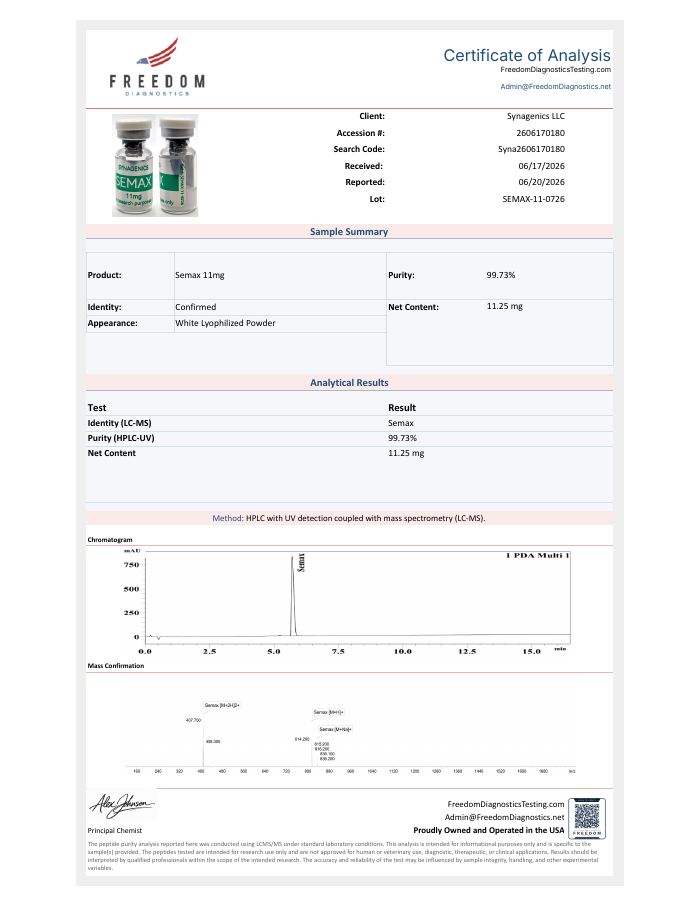
Structure and the Pro-Gly-Pro tail
The Met-Glu-His-Phe segment gives Semax its relationship to the ACTH(4-7) fragment, while the Pro-Gly-Pro motif is a stabilizing cap. Researchers who study peptide stability often use Semax as an example when comparing how terminal modifications change half-life in serum-containing medium or in purified peptidase assays.
The sequence contains a methionine residue, which matters analytically. Methionine can oxidize to the sulfoxide during synthesis, handling or analysis, producing an impurity with a mass 16 Da higher than the parent peptide. A careful mass spectrum will show whether that species is present, which is one reason the spectrum should be read and not merely filed.
Areas of laboratory research
The Semax literature spans several in vitro and biochemical areas. The groupings below describe model systems, not any use beyond the laboratory.
Neuronal cell culture
Neuronal-like cell lines and primary neuron cultures are used to examine how short neuropeptide analogs behave in defined media over time.
Neurotrophin expression
Transcript and protein studies in culture look at neurotrophin and receptor expression, usually by RT-qPCR, ELISA or western blotting with matched controls.
Peptidase stability assays
Serum and purified peptidase systems measure how quickly a peptide is cleaved, using HPLC or LC-MS to follow the intact molecule.
Methods used to study short neuropeptide analogs
- LC-MS stability profiling. The intact peptide and its fragments are followed over time in serum, plasma or buffer containing a defined peptidase.
- Receptor binding assays. Radioligand or fluorescent competition assays test whether a peptide interacts with a given receptor, with appropriate positive and negative controls.
- Gene expression panels. RT-qPCR and RNA sequencing compare treated and control cultures at defined time points.
- Protein readouts. ELISA and western blotting report protein levels and phosphorylation states for the pathway under study.
- Cell viability controls. Metabolic and membrane-integrity assays confirm that a readout reflects the intended variable rather than toxicity.
Because the peptide is short and well defined, each of these assays can use a matched scrambled or truncated control, which strengthens interpretation.
Designing a clean in vitro experiment
- Choose the right control. A scrambled heptapeptide and the Met-Glu-His-Phe fragment alone help separate sequence effects from the effect of the tail.
- Account for peptidases. Serum contains peptidases that degrade peptides during the experiment, so state the serum percentage and consider a serum-free condition.
- Check for oxidation. Run or request a mass spectrum that resolves the parent ion from the +16 Da methionine sulfoxide species.
- Standardize the cells. Use consistent passage numbers, plating density and differentiation protocol across arms.
- Record the lot. Link every dataset to a lot number and repeat key results with a second lot where possible.
- Replicate independently. Independent biological replicates matter more than technical wells.

Analytical standards for Semax
A seven-residue peptide with an oxidation-sensitive residue needs a closer read than a simple tripeptide. A complete report should let you confirm each of the points below.
- HPLC purity. A single dominant peak with a clean baseline, plus the method and gradient used.
- Mass spectrometry. The observed mass should match about 813.9 g/mol for the intact peptide, with no dominant +16 Da species.
- Peptide content. Net peptide content shows how much of the powder is peptide rather than counter-ion and moisture.
- Lot tracking. The lot on the vial must match the lot on the report.
Browse lot-level results in the Certificate of Analysis library.
How to read a Semax certificate of analysis
Three checks cover most of what matters on a report.
1. Identity
The spectrum should show the intact peptide mass and not a dominant oxidized or truncated species.
2. Purity
Inspect the chromatogram and the integration, not only the headline percentage.
3. Traceability
Compound name, lot number and test date must match your vial.
See how every lot is documented in our quality standards and in From Our Lab.
Glossary: neuropeptide and stability terms
Precise terminology makes it easier to read neuropeptide literature and to compare certificates of analysis between sources. These are the terms used on this page.
| ACTH | Adrenocorticotropic hormone, a 39-amino-acid peptide. Semax is built from a short fragment of its sequence plus a stabilizing tail. |
|---|---|
| Melanocortin receptor | A family of G protein-coupled receptors that bind ACTH-related peptides. Receptor binding assays test whether a fragment engages them. |
| Neurotrophin | A secreted protein that supports neuronal survival and differentiation in culture, such as brain-derived neurotrophic factor. |
| Peptidase | An enzyme that cleaves peptide bonds. Serum and cell lysates contain many, which limits how long unmodified peptides survive in medium. |
| Pro-Gly-Pro | A proline-rich C-terminal motif that resists cleavage by many peptidases and stabilizes the molecule. |
| Methionine sulfoxide | The oxidized form of methionine. It adds 16 Da to the peptide and is a common impurity to look for in the mass spectrum. |
| LC-MS | Liquid chromatography coupled to mass spectrometry, used to separate a peptide from related species and confirm its mass. |
| Net peptide content | The percentage of a lyophilized powder that is peptide rather than counter-ion and bound water. |
Semax in the wider neuropeptide research landscape
Semax belongs to a long tradition of using short peptide fragments to probe larger signaling molecules. Fragments of ACTH, for example, have been used to separate the effects of the receptor-binding core from the effects of the full hormone. Modifying a fragment with a stabilizing tail then asks a second question: how much of a peptide’s behavior in a culture dish is driven by its sequence, and how much by how long it survives in the medium?
That second question is why stability work sits alongside cell-based assays in the Semax literature. A peptide that is degraded within minutes of reaching the culture will give a very different result from one that persists for hours, even when both bind the same target. Good experiments therefore measure the intact peptide at the start and end of the incubation, using LC-MS or HPLC, and report the half-life they observed under their own conditions.
For a laboratory choosing a reagent, the lesson is to treat the peptide as a variable that must itself be measured. Document the lot, confirm the mass, state the medium, and keep a matched control. Those habits make a Semax experiment reproducible, and they apply equally to every other peptide in the Cellular Research Hub.
Reporting a Semax experiment so others can repeat it
A methods section for a peptide experiment should let another laboratory reproduce it exactly. For Semax, include the points below.
- The full sequence, the supplier and the lot number, with the purity and mass reported on the certificate.
- The counter-ion form and how the stock concentration was calculated, including whether net peptide content was applied.
- The cell line, passage range and authentication method.
- The medium, serum percentage and lot, and whether any protease inhibitors were present.
- The incubation time, and the measured stability of the intact peptide over that time.
- The controls used and the number of independent replicates.
These details are short to write and make an enormous difference to reproducibility.
Changing suppliers? Read our Peptide Sciences alternative guide, and check the current Synagenics coupon codes before you order.
Semax research FAQ
What is Semax?
Semax is a synthetic heptapeptide, Met-Glu-His-Phe-Pro-Gly-Pro, derived from an ACTH fragment with a stabilizing Pro-Gly-Pro tail. In the laboratory it is used as a defined peptide in cell culture and stability research.
Is Semax sold for human or animal use?
No. Synagenics supplies Semax strictly as a research-use-only material for qualified laboratory work. It is not a drug, supplement or cosmetic, and nothing on this page is a claim about use in people or animals.
Why does the Pro-Gly-Pro tail matter?
Proline-rich C-terminal sequences resist many peptidases, so the tail makes the peptide more stable in biological media than the unmodified ACTH fragment. Researchers use that property in stability assays.
What is methionine oxidation and why check for it?
Methionine can oxidize to methionine sulfoxide, adding 16 Da to the mass. A mass spectrum that resolves this species shows whether oxidation is present in a lot.
How is research-grade Semax verified?
Purity is reported by reversed-phase HPLC and identity by mass spectrometry. Each lot has a lot number so the Certificate of Analysis can be matched to your material.
Where can I see a Certificate of Analysis?
Lot-level results are published in the public library at synagenics.com/coas/, searchable by compound or lot number.
Related research
Continue exploring the Synagenics research library.
Looking for research-grade Semax with lot-level data?
Every Synagenics lot is documented and third-party tested, with certificates published in the open COA library.
Buy Semax research peptideBrowse certificates of analysisRead the quality standards
For qualified laboratory research use only. Not for human or animal use. These statements have not been evaluated by the US Food and Drug Administration.
